
Be With You
2018
No user ratings available yet
Representation score: 1.4 out of 10
Representation Score
Fair
2008
Director
Park Dae-young
Runtime
96 minutes
Average Rating
No ratings yetNew Showbiz Analysis
Humming is a traditional romantic melodrama that prioritizes individual emotional development over social critique. The narrative relies heavily on established genre conventions, focusing on the internal realization of a male protagonist through a romantic connection. The film lacks depth in representing diverse lived experiences. Characters are used primarily to fulfill specific emotional functions rather than representing a range of identities. While it provides a culturally specific South Korean perspective, it does not actively disrupt social hierarchies or explore non-traditional identities. Ultimately, the work functions as a standard genre piece. It centers on sentimental values and conventional relationship dynamics rather than progressive social commentary or systemic representation.
Category Breakdown
The story focuses on a heterosexual romantic relationship between Jun-seo and Mi-yeon. It adheres to conventional romantic clichés without exploring non-traditional sexual orientations or gender identities.
The narrative follows a traditional arc where the female lead's vulnerability catalyzes the male protagonist's emotional growth. This reinforces classical, gendered melodrama dynamics.
As a South Korean production, the film offers a specific cultural lens. However, the narrative appears to focus on a homogeneous social unit without much diversity.
The film emphasizes individual emotional fulfillment and the sanctity of romantic bonds. It operates within traditional romanticism rather than challenging institutional structures.
A medical coma serves as a primary plot device to drive the protagonist's arc. The film lacks a nuanced exploration of the lived experience of being in a coma.
Present on Screen
Limited or Absent
Official Synopsis
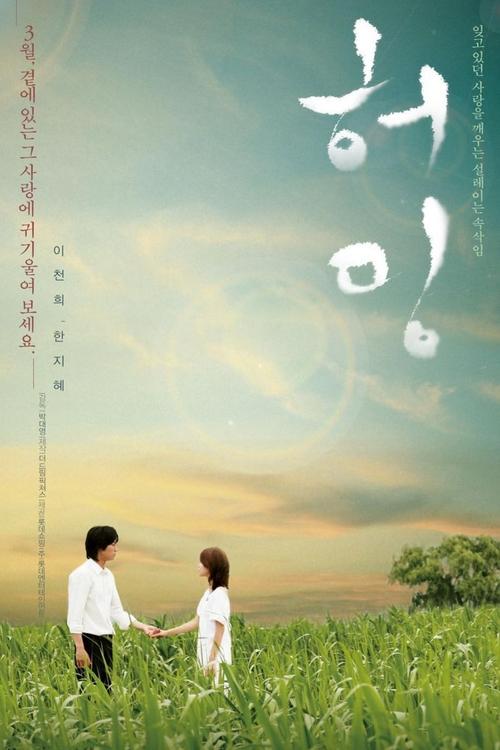
Jun-seo is tired of the relationship he is in with Mi-yeon. But one day she is in an accident and falls into a coma. Then, unbelievably Mi-yeon visits him the next day just like any other ordinary day. He starts searching for other traces of Mi-yeon and realizes how much he loved her. Will he discover the love he has never realized, which has always existed close by him?
2018

2011

2006

2004

2007

2000
2010

2004
No reviews yet. Be the first to share your thoughts on this movie!
Use the rating form above to leave a star rating and optional review.