Young Cassidy
1965
No user ratings available yet
Representation score: 4.2 out of 10
Representation Score
Fair
1972
RDirector
John Mackenzie
Runtime
101 minutes
Average Rating
No ratings yetNew Showbiz Analysis
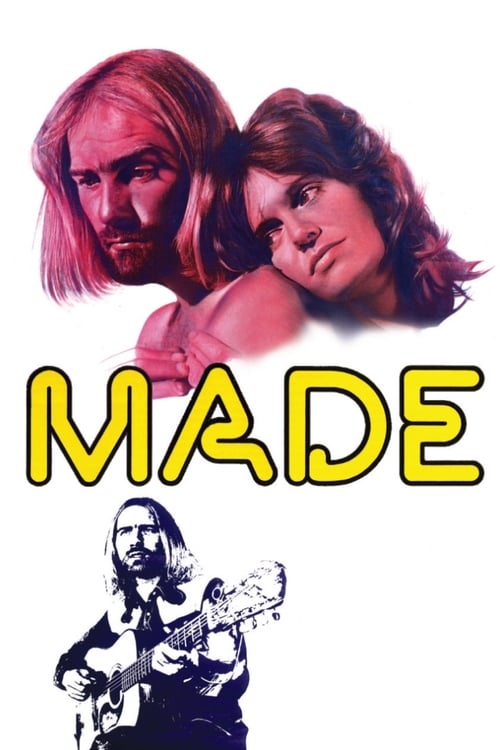
Made opens on the sterile, fluorescent-lit isolation of a Brighton hospital corridor, framing Valerie Marshall (Carol White) as a single mother trapped between the demands of her infant son, her ill mother, and a social world that offers no support. The film’s argument is that traditional institutions—church, family, and the state—are hollow, leaving the individual to bear the burden of survival alone. Valerie’s interactions with Mike (Roy Harper), a distant folk singer, and Father Dyson (John Castle), a hollow priest, underscore this failure: Mike offers emotional absence, while Dyson provides only empty platitudes. The camera lingers on Valerie’s exhausted face, granting her the beauty lighting of sympathy, but it also emphasizes the sterile, empty spaces around her, suggesting that her isolation is the true subject. The film’s internal logic pulls apart when it frames Valerie’s suffering as a rational response to a hostile world, yet it also reduces her to a victim of circumstance, with no agency or resolution. The last image, Valerie standing alone in a dimly lit room, is a verdict of hollow resignation: the system has failed, and she has survived, but at the cost of her innocence and hope. In the context of 1970s British social commentary, Made is a sincere but contrived illustration of the plight of a working-class woman, pinioned by cliché yet unflinching in its depiction of institutional failure.
Category Breakdown
No queer identities appear; romantic dynamics remain strictly heterosexual. Valerie’s interactions with Mike, Mahdav, and Father Dyson follow conventional gendered scripts. The film offers no same-sex intimacy or non-binary presence on screen.
Valerie anchors the moral and emotional center, burdened by caregiving for her infant and ill mother. Men are framed as inadequate or invasive: Mike is distant, Mahdav aggressive, and Father Dyson hollow. Valerie bears the weight of survival alone.
The cast is entirely white, reflecting the 1972 British setting with no non-white characters. Race functions as an unmarked default, with no exploration of ethnic diversity. Cross-cultural dynamics are absent from the narrative and visual composition.
Traditional institutions like church and family are portrayed as failing or oppressive. Father Dyson’s platitudes and Mrs. Marshall’s domesticity highlight the emptiness of established support structures. Valerie’s isolation underscores the individual’s struggle against a cold, unhelping system.
Mrs. Marshall’s multiple sclerosis drives the plot, depicted as physical decline and emotional burden. The film shows daily caregiving realities, but the disability remains a plot device. It serves Valerie’s suffering rather than a fully realized aspect of Mrs. Marshall’s identity.
Present on Screen
Limited or Absent
Official Synopsis
This compelling emotional drama stars Carol White as a young single mother who finds herself caught between two people – a local priest and a folk singer – each of whom wants to convert her to his own worldview. An elegy to a younger generation looking for something to believe in, Made co-stars hugely influential folk-rock musician Roy Harper in his screen debut. Produced by Joseph Janni – who previously made the astonishingly successful Poor Cow with White – directed by The Long Good Friday's John Mackenzie and featuring new songs specially composed by Harper.
1965
1973
1967
1982
1970
1981
1971
1970
No reviews yet. Be the first to share your thoughts on this movie!
Use the rating form above to leave a star rating and optional review.