Honky Tonk
1941
No user ratings available yet
Representation score: 1.7 out of 10
Representation Score
Minimal
1950
PassedDirector
Allan Dwan
Runtime
90 minutes
Average Rating
No ratings yetNew Showbiz Analysis
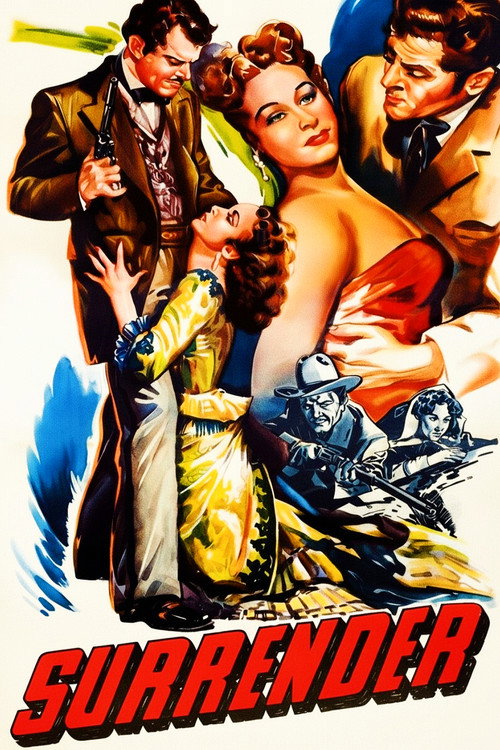
Surrender is a quintessential mid-century Western that adheres to the social hierarchies and narrative structures typical of 1950s Hollywood. The film focuses on individual ambition and romantic conflict within a framework of traditional moral values. The story relies heavily on established genre clichés, particularly the femme fatale archetype. While the female lead drives the plot, her actions are framed as manipulation and material gain rather than a challenge to patriarchal norms. Ultimately, the film offers little disruption to the status quo. It focuses on individual morality and romantic melodrama within a framework of traditional gender and class hierarchies.
Category Breakdown
The film does not depict any queer identities either explicitly or implicitly. All romantic relationships are between heterosexual couples.
Violet Barton drives the plot as a femme fatale, but her actions are portrayed as a moral failing. The narrative emphasizes traditional gender roles and conflicts.
The story centers on Texas wealth and social standing among a primarily Anglo-Saxon cast. It does not challenge colonial perspectives or give ability to act to non-white characters.
The plot upholds traditional Western values, focusing on individual wealth and social standing. It supports legal and social structures without challenging them.
There is no representation of physical, sensory, or neurodivergent identities in the film.
Present on Screen
Limited or Absent
Official Synopsis
Violet Barton, a femme-fatale goal-setter, fascinates men and readily returns their affection to obtain the wealth she desires, even to the point of bigamy. She has an affair with gambler Gregg Delaney but marries his best friend, Johnny Hale, when she discovers Hale is the richest man in Texas. This loses her the respect of her sister, Janet, who loves Hale, and Delaney, who loves Violet. Meanwhile, town sheriff Bill Howard is working hard to get Delaney to confess to a murder.
1941

1954

1955
1940
1958
1945
1934
1946
No reviews yet. Be the first to share your thoughts on this movie!
Use the rating form above to leave a star rating and optional review.