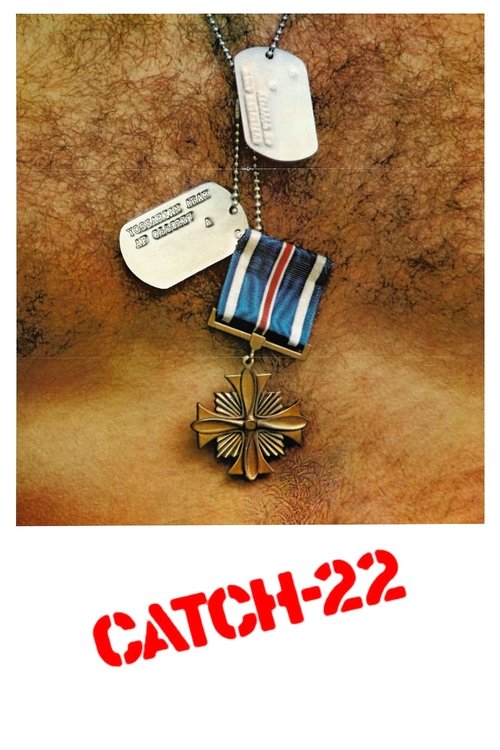
Catch-22
1970
No user ratings available yet
Representation score: 4.4 out of 10

Representation Score
Good
1970
RDirector
Robert Altman
Runtime
116 minutes
Average Rating
No ratings yetNew Showbiz Analysis
Robert Altman’s M*A*S*H is a subversive deconstruction of the war genre that prioritizes communal survival over military heroism. It excels in its critique of institutional authority and its refusal to rely on submissive female clichés, offering a more complex social ecosystem than many of its contemporaries. However, the film is limited by a narrow demographic focus. The narrative remains largely homogeneous, focusing on an American medical unit while neglecting the local Korean population and lacking meaningful LGBTQ+ or racial representation. Ultimately, the film's strength lies in its cultural and gendered subversions. While it lacks demographic breadth, its challenge to rigid social and military hierarchies marks it as a progressive work of its era.
Category Breakdown
The film does not feature prominent LGBTQ+ characters or explicitly address non-straight identities. While the setting promotes a free and unrestrained approach to sexuality, these depictions remain centered around the assumption that everyone is straight or cisgender.
The narrative challenges traditional gender roles by giving female characters significant influence and independence. Nurse Kelly, in particular, is shown as intellectually autonomous and sexually empowered, playing an active role in the unit's irreverent culture.
The focus remains almost entirely on the American medical unit. The narrative does not engage with the local population or provide meaningful representation of non-white identities within the main cast.
The film provides a strong critique of Western institutionalism and military bureaucracy. It celebrates anti-authoritarian themes by presenting the protagonists' rebellion as a necessary form of psychological survival.
The film addresses the psychological impact of war through character trauma. However, these mental strains are framed as environmental byproducts rather than a focused exploration of specific mental health conditions.
Present on Screen
Limited or Absent
Official Synopsis
One of the world's most acclaimed comedies, M*A*S*H focuses on three Korean War Army surgeons brilliantly brought to life by Donald Sutherland, Tom Skerritt and Elliott Gould. Though highly skilled and deeply dedicated, they adopt a hilarious, lunatic lifestyle as an antidote to the tragedies of their Mobile Army Surgical Hospital, and in the process infuriate Army bureaucrats. Robert Duvall, Gary Burghoff and Sally Kellerman co-star as a sanctimonious Major, an other-worldly Corporal, and a self-righteous yet lusty nurse.
1970
1959
1987

1988

1964
1955

1986
1942
No reviews yet. Be the first to share your thoughts on this movie!
Use the rating form above to leave a star rating and optional review.