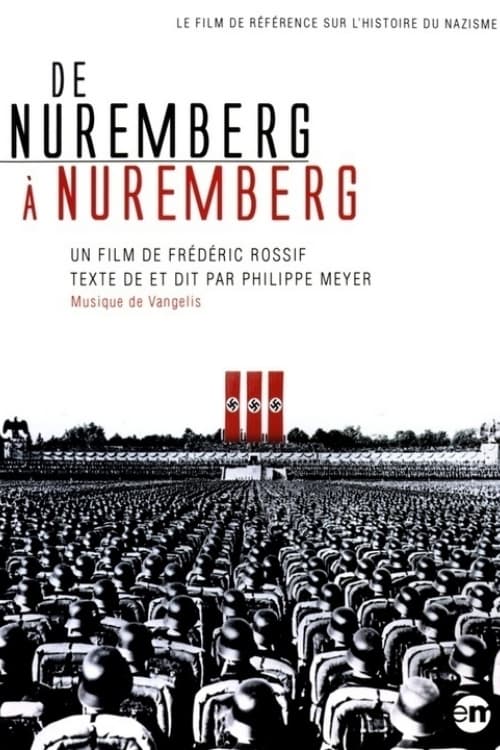
De Nuremberg à Nuremberg
1989
No user ratings available yet
Diversity score: 6.1 out of 10

2008
Director
Ari Libsker
Runtime
63 minutes
Average Rating
No ratings yetSynopsis
Stalags were pocket books whose plots revealed lusty female SS officers sexually abusing camp prisoners. During the 1960s, parallel to the trial held against Nazi war criminal Adolf Eichmann, sales of this pornographic literature broke all records in Israel and hundreds of thousands of copies were sold at kiosks. The popularity of the Stalags only declined after a much-reported trial, in which their authors were accused of distributing anti-Semitic pornography. This film examines the notorious phenomenon, exposing the creators of this genre for the first time. It posits that the combination of pornography and the Holocaust also appears in canonic Holocaust literature and continues to be a widespread part of the representation of the Holocaust in Israel today.
Overall Score
Good
Category Breakdown
LGBTQ+ Representation
The film examines sexual desire and wartime power dynamics through the lens of the Stalags pocket books. While it focuses on heteronormative exploitation, it provides a critical framework for understanding how sexualization mediates power.
Gender Representation
The narrative disrupts conventional wartime gender roles by analyzing the 'lusty female SS officer' trope. It critiques how these aggressive, predatory archetypes were constructed to serve specific commercial and psychological purposes.
Racial & Ethnic Diversity
The documentary explores the tension between Jewish identity and the consumption of anti-Semitic pornography. It examines how ethnic trauma is commodified and re-represented within the specific historical context of Israel.
Religious & Cultural Diversity
The film excels by challenging the sanctity of historical memory and traditional cultural narratives. It deconstructs how pornography and the Holocaust were blended into a commercialized product for mass consumption.
Disability Representation
There is no evidence regarding the portrayal of physical or neurodivergent disabilities in this work.
Strengths
Areas for Improvement
AI Analysis
Stalags is a sophisticated piece of media criticism that deconstructs how pornographic literature interacts with historical trauma. Rather than a standard historical recount, it treats the pocket book as a site of sociological and political conflict. The film's strength lies in its willingness to challenge 'sacred' historical narratives. It provides a nuanced analysis of how identity, sex, and power are manipulated within the public consciousness, particularly regarding the commodification of the Holocaust. However, the film remains focused on heteronormative power dynamics and specific ethnic traumas. It does not explicitly center LGBTQ+ identities or address disability representation, limiting its scope to the intersection of sex and systemic power.
No reviews yet. Be the first to share your thoughts on this movie!
Use the rating form above to leave a star rating and optional review.