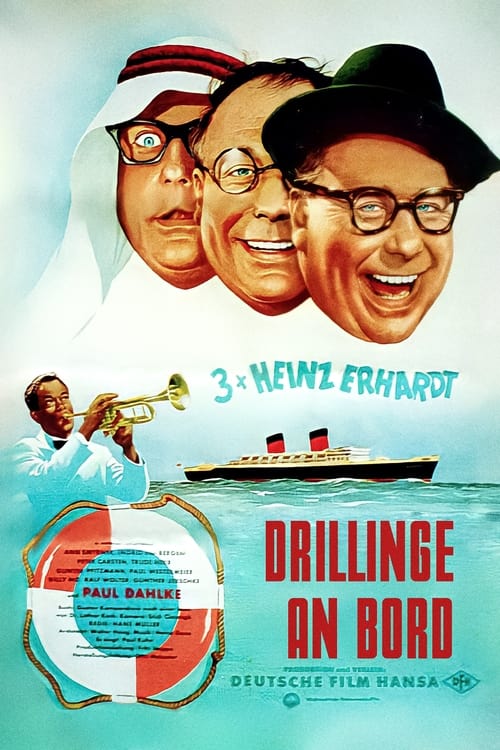
Drillinge an Bord
1959
No user ratings available yet
Diversity score: 2.7 out of 10

1958
Director
Sergei Sidelyov
Runtime
73 minutes
Average Rating
No ratings yetSynopsis
Chief accountant Porfiry Petrovich Smirnov-Alyansky, who took a good walk on the anniversary of his colleague cashier Ivan Zakharovich Vodnev, climbs into the traffic controller's booth and disrupts traffic on one of the streets of Leningrad. However, the guard Vasiliy Shaneshkin mistakenly delivers to the police station not an escaped offender, but a quite decent cashier. In addition, Vodnev, offended by the police, turns out to be the father of the bride Shaneshkin — Katya. Vasiliy admits his guilt, but, not daring to explain himself, leaves the angry Ivan Zakharovich with bad thoughts about the Soviet police. Fortunately, the young sergeant will soon have an opportunity to prove to others the responsibility and conscientiousness of the police officers.
Overall Score
Limited
Category Breakdown
LGBTQ+ Representation
The film follows traditional romantic and familial structures typical of the 1958 era. There is no evidence of LGBTQ+ characters or narratives that critique heteronormativity.
Gender Representation
The plot centers on male professional and social errors. While Katya is a bride, her role is defined by her connections to the male protagonists.
Racial & Ethnic Diversity
Set in Leningrad, the film reflects the demographic homogeneity of Soviet-era domestic productions. No multi-ethnic cast or diverse ethnic representation is indicated.
Religious & Cultural Diversity
The story explores the relationship between individuals and state institutions. It reinforces the importance of professional duty and social order within the Soviet framework.
Disability Representation
The narrative contains no mention of characters with visible or invisible disabilities. No such characters are used as plot devices.
Strengths
Areas for Improvement
AI Analysis
Street Is Full of Surprises is a character-driven comedy that prioritizes social misunderstanding and the affirmation of civic responsibility. The narrative architecture adheres strictly to the traditional social and institutional hierarchies of 1958 Soviet cinema. The film lacks intersectional representation, focusing instead on a central conflict between male characters. While it explores the friction between individual error and institutional integrity, it does so through a lens of state-sanctioned social cohesion. Ultimately, the work functions as a period piece that reinforces existing social structures rather than offering systemic critique or diverse perspectives.
No reviews yet. Be the first to share your thoughts on this movie!
Use the rating form above to leave a star rating and optional review.