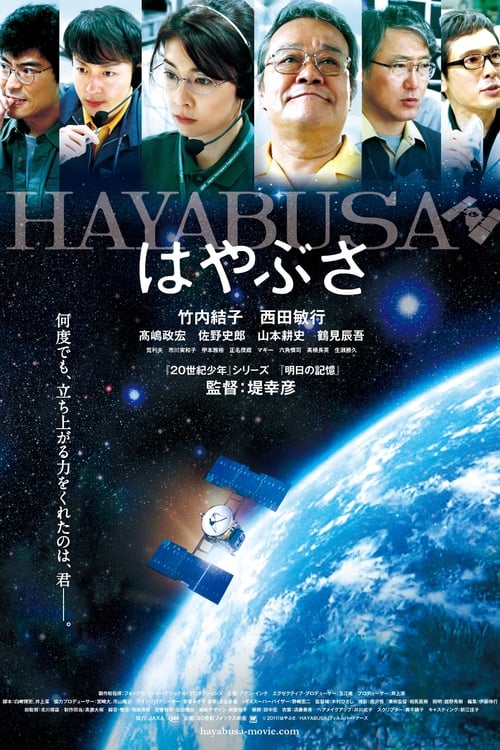
Hayabusa
2011
No user ratings available yet
Representation score: 5.4 out of 10

Representation Score
Limited
2012
Director
Tomoyuki Takimoto
Runtime
136 minutes
Average Rating
No ratings yetNew Showbiz Analysis
Hayabusa: The Long Voyage Home dramatizes the JAXA team’s effort to return asteroid samples, emphasizing national pride and technical perseverance. The narrative is tightly focused on a homogeneous, male-dominated group, reflecting the real-world composition of the mission team. Cultural representation is strong, with the film honoring Japan’s scientific achievement and collective resilience after the 2011 tsunami. However, the lack of LGBTQ+, disability, and broader ethnic representation limits its inclusivity. The film’s narrow focus on a specific national and professional group results in a low overall diversity score, despite its meaningful cultural resonance.
Category Breakdown
The narrative centers on the JAXA team behind the Hayabusa mission without featuring any LGBTQ+ characters. No queer identities or relationships are shown or identified within the story.
The plot primarily follows male engineers and scientists managing the spacecraft’s return. Women appear in the cast but do not drive the central narrative or hold leading roles.
The cast is entirely Japanese, mirroring the real-life national team at JAXA. No characters of other ethnicities are featured in the story.
The film celebrates Japan’s technological achievement and national pride following the 2011 tsunami. It portrays the space agency and its mission as heroic and unifying.
No characters with physical or mental disabilities appear in the film. The story does not address disability themes or representation.
Present on Screen
Limited or Absent
Official Synopsis
In May 2003, the Japan Aerospace Exploration Agency (or JAXA) launched an unmanned spacecraft of their own development to retrieve samples from an asteroid. Seven long years later, Hayabusa achieved its goal and was the first of any kind of craft launched from Earth to safely return samples of this kind to home base. The story was one of such great national pride for Japan, and in the wake of the tsunami and resulting tragedies in Japan it’s strong nationalistic message became the subject of no less than three rival films. Yukihiko Tsutsumi’s high-profile effort, simply titled Hayabusa (2011) starred the incomparable Toshiyuki Nishida. Most recently, Welcome Home, Hayabusa (2012) was released to Japanese audiences. Slipping in between those two was Hayabusa: The Long Voyage Home, concentrating on the people on the ground who helped return the probe safely.
2011

2013

1996

2017

2012

2019

1960

2015
No reviews yet. Be the first to share your thoughts on this movie!
Use the rating form above to leave a star rating and optional review.