Wings of the Morning
1937
No user ratings available yet
Representation score: 2.4 out of 10
Representation Score
Minimal
1944
ApprovedDirector
George Blair
Runtime
56 minutes
Average Rating
No ratings yetNew Showbiz Analysis
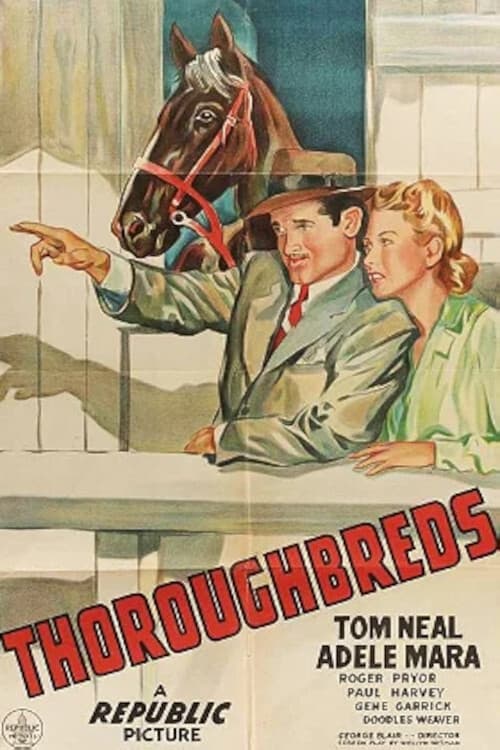
Thoroughbreds is a conventional mid-century romantic drama that adheres strictly to the social hierarchies of 1944. The narrative follows a standard rivalry-to-romance arc, centering on a heterosexual relationship and traditional Western institutions. The film lacks representation of diverse identities, focusing instead on the military and the wealthy socialite class. While the female lead possesses some individual interests, the story's resolution reinforces traditional gender roles and institutional stability. Ultimately, the film functions as a product of its era, prioritizing established cinematic formulas over any subversion of systemic power dynamics or identity-based narratives.
Category Breakdown
The story focuses on a traditional heterosexual romance between Rusty and Sally. There are no characters with non-straight or non-cisgender identities, nor any critique of the assumption that everyone is straight or cisgender.
Sally Crandall shows strength through her equestrian interests, but the plot ultimately resolves into a romantic partnership with the male lead. The power dynamics remain centered on the male protagonist.
The setting involves the U.S. Cavalry and wealthy socialites, environments that historically prioritize homogeneous white casts. There is no evidence of racial diversity or subversion of norms.
The film focuses on Western institutions like the military and high society. It prioritizes individual romantic fulfillment and tradition over critiques of social or religious structures.
A medical discharge facilitates the protagonist's transition to civilian life. It is unclear if this serves as a meaningful exploration of disability or functions strictly as a plot device.
Present on Screen
Limited or Absent
Official Synopsis
Sgt. Rusty Curtis of the U.S. Cavalry is unhappy about the Army's plan to replace horses with tanks so, after a medical discharge, he tries to buy his old military mount Sireson. Unfortunately, the father of wealthy socialite Sally Crandall outbids him with plans to train Sireson for a steeplechase race. Sally and Rusty develop a rivalry because she has a favorite horse of her own, but when her horse is hurt she and Rusty declare a truce and begin a romantic relationship.
1937
1945

2006
1961
1937

1937
1926
1955
No reviews yet. Be the first to share your thoughts on this movie!
Use the rating form above to leave a star rating and optional review.