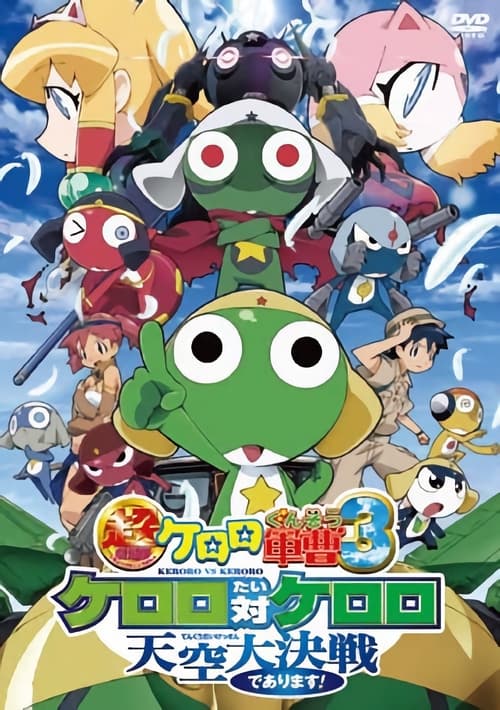
Sergeant Keroro The Super Duper Movie 3: Keroro vs. Keroro Great Sky Duel
2008
No user ratings available yet
Diversity score: 5.1 out of 10

2007
Director
Susumu Yamaguchi, Junichi Sato
Runtime
95 minutes
Average Rating
No ratings yetSynopsis
Another Kiruru appears in the South Pacific, but it was defeated by two unknown entities that look like Keronians, with subtle differences. Meanwhile, Keroro and the gang goes for a trip sponsored by Momoka to a private island. There, an alien named Meru, who claims himself as the prince of the deep sea, captures them, and aims to make Natsumi his princess, and that they had captured Keroro, who pleads to them to assist the Keroro Platoon, only to be kicked out.
Overall Score
Limited
Category Breakdown
LGBTQ+ Representation
The story centers on a traditional romantic pursuit involving the antagonist Meru and Natsumi. There is no evidence of non-cisnormative identities or same-sex intimacy within the narrative.
Gender Representation
Female characters drive much of the plot's tension, particularly Natsumi. However, the power dynamics largely follow traditional archetypes without overtly subverting established gender hierarchies.
Racial & Ethnic Diversity
Human racial diversity is secondary to the sci-fi premise involving extraterrestrial entities. The focus remains on the distinction between invaders and hosts rather than real-world ethnic hierarchies.
Religious & Cultural Diversity
The film uses a fish-out-of-water comedic structure involving alien intervention. The disruption of social order serves as slapstick comedy rather than a critique of specific cultural institutions.
Disability Representation
There is no discernible evidence regarding the portrayal of physical, sensory, or neurodivergent disabilities. No characters are identified by specific disabilities that drive the plot.
Strengths
Areas for Improvement
AI Analysis
The film operates as a genre-standard science fiction comedy that prioritizes escapism over social critique. It relies heavily on established tropes of alien invasion and romantic pursuit, which limits its intersectional depth. While the extraterrestrial cast offers a metaphorical exploration of 'otherness,' the narrative does not use these characters to challenge systemic social structures. The storytelling remains rooted in the comedic conventions of its era. Ultimately, the work functions as a playful adventure rather than a vehicle for identity politics, focusing on situational morality and slapstick conflict rather than deconstructing complex social norms.
2008
1992

1988
2002

1991
2002
2018

1987
2017
No reviews yet. Be the first to share your thoughts on this movie!
Use the rating form above to leave a star rating and optional review.