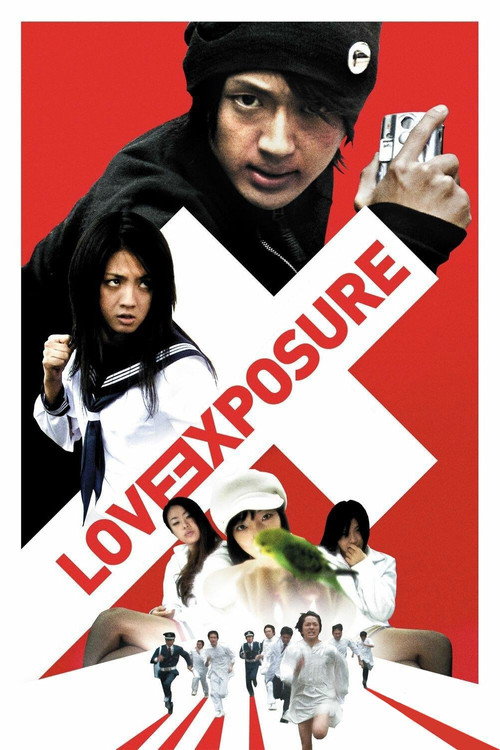
Love Exposure
2008
No user ratings available yet
Representation score: 8.8 out of 10
Representation Score
Good
2000
Director
Sion Sono
Runtime
108 minutes
Average Rating
No ratings yetNew Showbiz Analysis
Utsushimi is a postmodern exploration of obsession that prioritizes psychological surrealism over linear storytelling. It succeeds in deconstructing traditional social and gender hierarchies, replacing stable roles with a fragmented, dream-like reality. This subversion offers a departure from conservative, predictable narrative structures. However, the film remains limited by its cultural homogeneity and lack of characters who reflect more than one aspect of diversity. While it explores the instability of the human psyche, it often treats mental distress as a stylistic element rather than a deep exploration of disability or neurodivergence. Ultimately, the film is a study of individual mania. It challenges moral certainties but lacks the explicit diversity required to address broader social identities like race or LGBTQ+ experiences.
Category Breakdown
The film centers on intense, obsessive romantic fixations without explicitly depicting LGBTQ+ identities or non-straight storylines. Instead, it explores psychologically destabilized romantic dynamics.
Gender roles are challenged through psychological volatility rather than traditional domestic hierarchies. The narrative replaces stable leadership with individual mania and mental fragmentation.
Set in a contemporary Japanese urban environment, the film operates within a culturally homogeneous framework. It lacks race-blind casting or the intentional blending of diverse ethnic identities.
The narrative embraces moral relativism and subjective reality through a dream-like lens. It rejects social cohesion and traditional stability by prioritizing individual truth over objective morality.
Themes of mental instability serve as stylistic devices for surrealism. The film risks using psychological distress as an aesthetic tool rather than providing a nuanced portrayal of neurodivergence.
Present on Screen
Limited or Absent
Official Synopsis
While butoh master Akaji Maro is in rehearsal and fashion designer Shinichiro Arakawa prepares for the Paris collection, Sion begins a movie about a high school girl who falls in love... with a restaurant cook she's never even spoken to. Soon the artists' works come together in a race to help the girl's love.
2008

1992

2018

2012

2010
1997
1984

2021
No reviews yet. Be the first to share your thoughts on this movie!
Use the rating form above to leave a star rating and optional review.