Champagne for Two
1947
No user ratings available yet
Representation score: 1.3 out of 10
Representation Score
Minimal
1934
ApprovedDirector
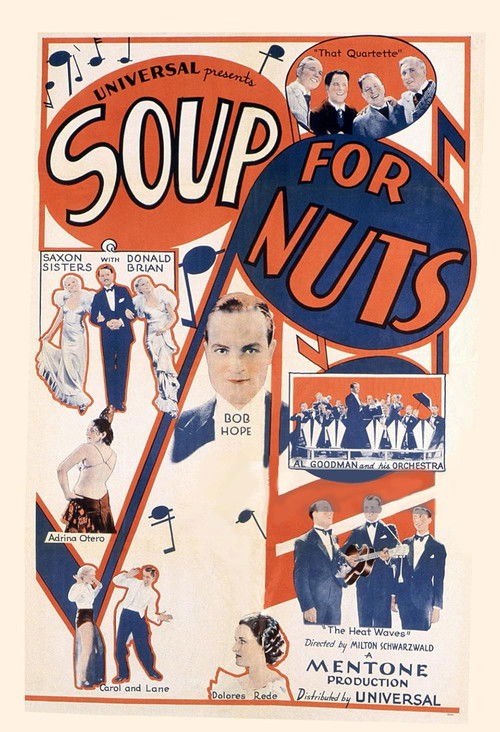
Milton Schwarzwald
Runtime
20 minutes
Average Rating
No ratings yetNew Showbiz Analysis
Soup for Nuts is a product of its time, functioning as a traditional comedy of manners that reinforces the social hierarchies of 1934. The narrative avoids progressive social critique, opting instead for established comedic structures and conventional interpersonal conflicts. The film's focus remains narrow, centering on marital fidelity and the preservation of a business. This results in a story that upholds the status quo rather than challenging existing gender or racial norms. Ultimately, the production reflects the homogeneous and straight-centered cinematic standards of the early 1930s, offering little in the way of characters who reflect more than one aspect of diversity or systemic subversion.
Category Breakdown
The film does not depict any non-binary or LGBTQ+ identities, focusing solely on heterosexual relationships and traditional courtship.
Gender dynamics rely on 1930s-era clichés, centered around a wife's jealousy over her husband's behavior. Allyn Gillyn sets club rules, which helps maintain marital stability.
There is no indication of a diverse or non-Anglo-Saxon cast. The New York City setting suggests a homogeneous demographic typical of mid-1930s musical comedies.
The narrative reinforces traditional Western social structures and the nuclear family unit. It prioritizes conventional social norms and the management of a commercial establishment.
The film provides no information regarding the inclusion or portrayal of characters with physical or neurodivergent disabilities.
Present on Screen
Limited or Absent
Official Synopsis
Bob Hope is the Master-of-Ceremonies at New York City's Carlton Club, which is going belly-up because the wife, Allyn Gillyn, of the owner, Donald Brian, won't let him book any female singers or acts because he has a penchant for hitting on them, and this makes her somewhat jealous and protective.
1947

1933
1934
1929

1937
1941
1937

1937
No reviews yet. Be the first to share your thoughts on this movie!
Use the rating form above to leave a star rating and optional review.