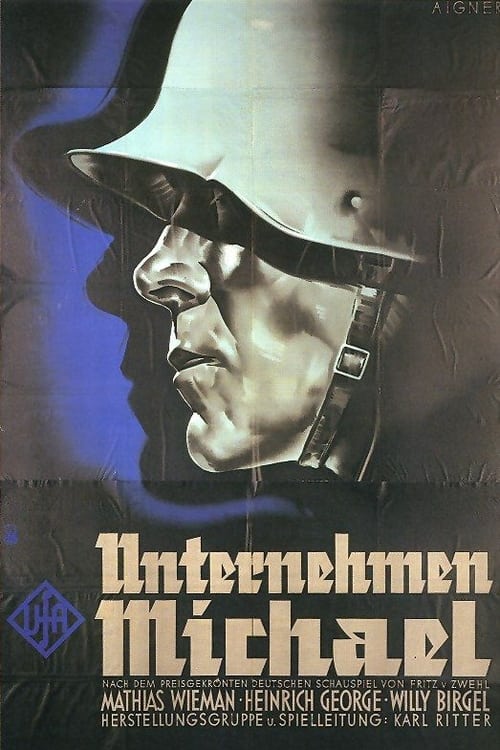
The Private's Job
1937
No user ratings available yet
Diversity score: 0.6 out of 10

1934
Director
Hans Zöberlein
Runtime
118 minutes
Average Rating
No ratings yetSynopsis
This Nazi propaganda film tells about the "freikorps" movement in post-World War I Germany. Freikorps were armed extreme-right-wing paramilitary groups, often composed of street thugs, ex-convicts and unemployed veterans, who engaged in street battles and assassinations of political opponents, usually leftist or Communist groups. Many of these "freikorps" were absorbed into the S.A. (Storm Troopers) and, later, the SS after Adolf Hitler came to power
Overall Score
Minimal
Category Breakdown
LGBTQ+ Representation
The film lacks any LGBTQ+ characters or narratives. Its ideological framework enforces strict heteronormativity, treating non-normative identities as non-existent or targets for suppression.
Gender Representation
The story prioritizes hyper-masculine archetypes centered on combat and political violence. Femininity is likely relegated to domestic roles secondary to the male-driven paramilitary struggle.
Racial & Ethnic Diversity
The narrative emphasizes a homogeneous, Aryan-centric worldview. It bolsters national identity through the exclusion of non-white or non-Germanic identities.
Religious & Cultural Diversity
The film promotes a radicalized, state-aligned version of national identity. It frames political opponents, such as communists, as the systemic 'other' to be eliminated.
Disability Representation
Physical and mental fitness serve as metrics of value. Disability is likely used as a plot device to denote weakness compared to the 'ideal' soldier.
Areas for Improvement
AI Analysis
Um das Menschenrecht is a Nazi propaganda film designed to glorify the Freikorps movement and paramilitary structures. The narrative architecture reinforces nationalist hierarchies and hyper-masculine archetypes of political violence. The film functions as a tool for social control, promoting ethnic homogeneity and the exclusion of any identities that do not align with the radicalized German nationalist identity of the era. Ultimately, the work seeks to validate existing power dynamics rather than subvert them, using the glorification of right-wing violence to uphold a singular, state-aligned morality.
1937
1941
1933

1935
1929
1944
1961
1968

1993
1973
2005
1940
No reviews yet. Be the first to share your thoughts on this movie!
Use the rating form above to leave a star rating and optional review.