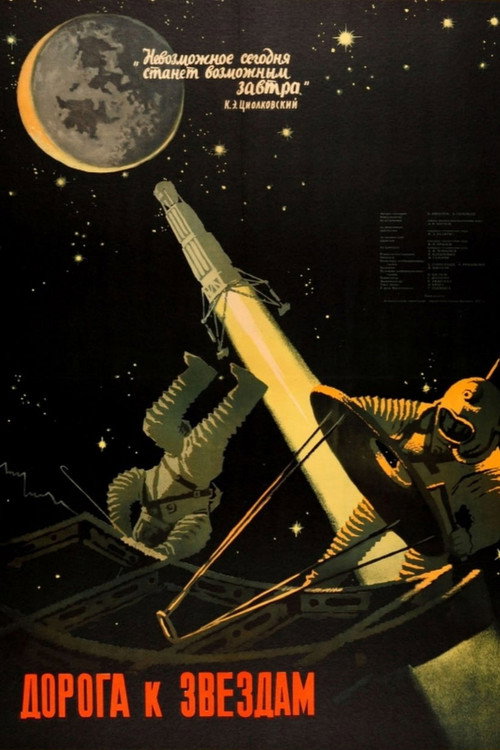
Road to the Stars
1957
No user ratings available yet
Representation score: 3.4 out of 10

Representation Score
Limited
1937
Director
Jean Painlevé
Runtime
11 minutes
Average Rating
No ratings yetNew Showbiz Analysis
Jean Painlevé’s work shifts the cinematic focus from human social dynamics to the vastness of the cosmos. The film’s strength lies in its philosophical departure from anthropocentrism, using scientific speculation to challenge the perceived primacy of the human experience. However, the film’s non-anthropocentric approach results in a near-total absence of social representation. Because the narrative avoids human characters, it cannot engage with identity, race, gender, or sexual orientation. Ultimately, the film is a study of scale rather than society, succeeding in disrupting terrestrial-centric perspectives but remaining a blank slate regarding the diverse spectrum of human identity.
Category Breakdown
The film focuses on celestial mechanics and cosmic distances, avoiding any depiction of LGBTQ+ themes or critiques of the assumption that everyone is straight or cisgender.
By centering on mathematical triangulation and astronomical speculation, the film avoids gendered clichés but does not offer any subversion of gender roles.
With its focus on astronomy, the film does not discuss race. The lack of human characters means it neither reinforces racial hierarchies nor offers opportunities for racial diversity.
The film uses cosmic relativism to challenge traditional Western anthropocentrism. By presenting humanity within a vast, indifferent universe, it questions the idea of a human-centric worldview.
As a speculative documentary about space and mathematics, there are no human characters, so there is no depiction of physical or neurodivergent traits.
Present on Screen
Limited or Absent
Official Synopsis
We begin on planet Earth, with a demonstration of measuring distances using triangulation. Then, an imaginary voyage begins from earth to the moon, on to Mars, Saturn, the closest star (besides the sun), and beyond to the edge of our universe. The film depicts imagined landscapes, and it speculates on universes beyond ours. It ends with philosophical musings about the significance of Earth.
1957
2017
1925
2022
2004

2019
2016
2005
No reviews yet. Be the first to share your thoughts on this movie!
Use the rating form above to leave a star rating and optional review.