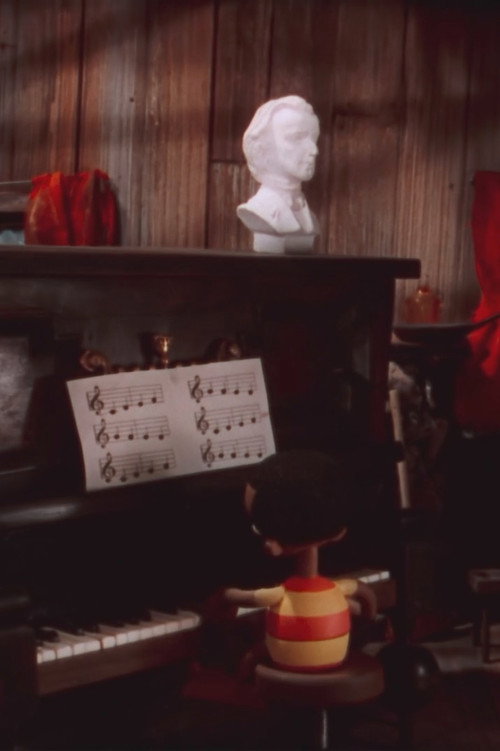
Jasper's Music Lesson
1943
No user ratings available yet
Representation score: 2.8 out of 10

Representation Score
Minimal
1941
ApprovedDirector
George Pal
Runtime
10 minutes
Average Rating
No ratings yetNew Showbiz Analysis
Rhythm in the Ranks is a product of its time, serving as a traditional animated short that upholds the social hierarchies of the early 1940s. The narrative follows a restorative arc where the protagonist must return to his prescribed military role to achieve redemption. The film heavily relies on conventional archetypes, especially concerning gender and institutional loyalty. It prioritizes escapism and the restoration of order over exploring diverse identities or systemic social structures. Ultimately, the work functions as a period piece reflecting the homogeneous and patriotic sentiments prevalent in cinema during the early years of World War II.
Category Breakdown
The film does not include any LGBTQ+ identities. The story centers around a male protagonist's romantic interest in a female ice skater.
Gender roles align with traditional mid-century stereotypes. The male soldier drives the narrative, while the female character mainly serves as a distraction from his duties.
The film seems to follow the homogeneous casting practices of 1941. There is no indication of diverse character designs or non-Western characters.
The story emphasizes institutional values and patriotism. It highlights the importance of military duty and fulfilling societal roles through service.
None of the characters have physical, sensory, or neurodivergent traits. The narrative does not address disability in any way.
Present on Screen
Limited or Absent
Official Synopsis
A toy soldier, distracted by a beautiful ice skater, is derelict in his duty and gets discharged. Later, when the screwball army declares war, he lucks into a chance to redeem himself. Preserved by the Academy Film Archive in partnership with UCLA Film & Television Archive in 2009.
1943
1942
1941
1945

1935

1943
1922

1934
No reviews yet. Be the first to share your thoughts on this movie!
Use the rating form above to leave a star rating and optional review.