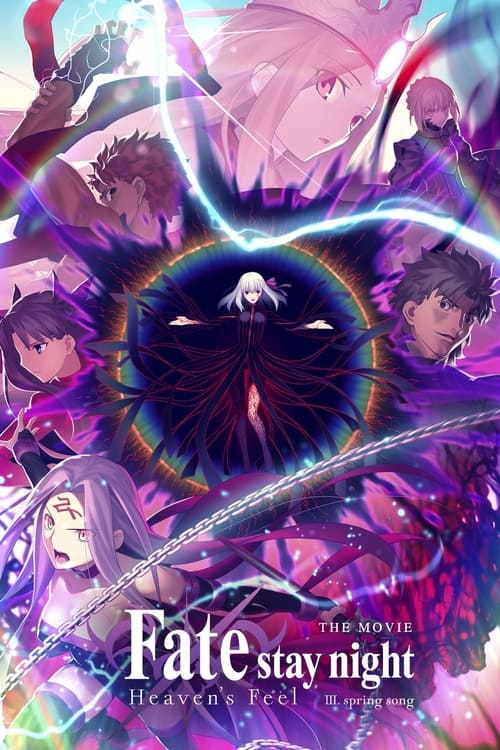
Fate/stay night: Heaven's Feel III. Spring Song
2020
No user ratings available yet
Representation score: 7.2 out of 10

Representation Score
Good
2019
RDirector
Tomonori Sudo
Runtime
117 minutes
Average Rating
No ratings yetNew Showbiz Analysis
This installment of the Heaven’s Feel trilogy stands out by breaking down the heroic archetype and focusing on the psychological decline of its characters. It excels in challenging traditional gender roles and criticizing institutional corruption, moving away from conventional fantasy clichés toward a more visceral, postmodern narrative. However, the film remains limited by its homogeneous cast and lack of explicit LGBTQ+ representation. Its cultural specificity restricts broader diversity.
Category Breakdown
The film centers on the romantic relationship between the main characters but does not explicitly focus on non-straight or non-cisgender identities or same-sex relationships.
The story challenges traditional gender roles by highlighting the ability to act of strong female characters like Sakura Matou and Rin Tohsaka, avoiding stereotypes of submissive women.
The cast is predominantly Japanese, reflecting the cultural and mythological context of the story. The film does not include actors from diverse racial backgrounds.
The narrative criticizes traditional institutions, presenting the family and magical authorities as oppressive forces. It blurs the line between heroes and villains through moral relativism.
Sakura’s storyline explores psychological and physical trauma in depth, treating her mental health as a core part of her identity rather than just a plot device.
Present on Screen
Limited or Absent
Official Synopsis
Shirou has lost his Servant, Saber, and is no longer a Master in the Holy Grail War. Despite this, he refuses to leave the battle, determined to protect Sakura. Meanwhile, a mysterious shadow engulfs the city, killing Masters and Servants one by one. As Shirou faces new dangers, Sakura is drawn deeper into her own destiny as a mage.
2020
2017
2017

2023

2010
2011
2012
2021
No reviews yet. Be the first to share your thoughts on this movie!
Use the rating form above to leave a star rating and optional review.