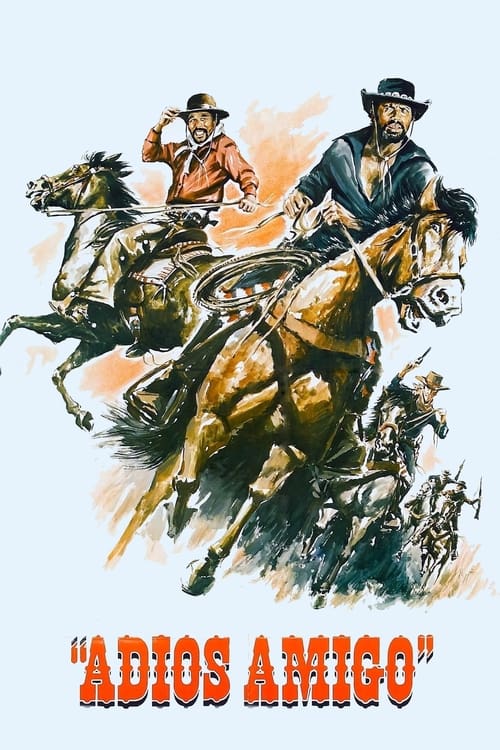
Adiós Amigo
1975
No user ratings available yet
Representation score: 4.0 out of 10

Representation Score
Fair
1970
XDirector
Robert A. Poore
Runtime
62 minutes
Average Rating
No ratings yetNew Showbiz Analysis
The film opens on a static, manicured suburban street, a picture of sterile order that immediately signals the suffocation to follow. Billed as a bank-robbery comedy, *Bunny and Clod* sells a critique of the American Dream where the house is the true protagonist and the inhabitants are merely small, insignificant figures trapped within its walls. The camera loves the architecture, not the people; the pristine lawns remain untouched while the characters inside them disintegrate into mechanical routines. The sold meaning is that suburban stability is a slow death. Dick Hansen’s heavyset "Clod" is the running gag, his physical clumsiness treated as a natural law of the environment rather than a character trait to be explored. He is never mourned; his incompetence is the price of conformity. The film’s argument pulls against its own low-budget energy: it claims to mock the domestic sphere, yet it offers no escape. The chaos of the outside world is contained by the neighborhood’s rigid structure, a moral arithmetic that rewards order over vitality. The ending mirrors the opening, returning to the quiet street to reinforce the loop. No one is rescued; no competence is achieved. The film’s final verdict is that the American Dream is a cage of one’s own making, where the "strong" male is just as vulnerable as the "weak" one. It is a cynical, if thin, portrait of 1970s malaise, where the only thing that remains intact is the beige exterior of the home.
Category Breakdown
No same-sex intimacy or identity markers appear. Heterosexual pairings dominate the softcore framing, keeping sexual dynamics strictly binary and conventional throughout the narrative.
Diana Evans serves as the conventional blonde object, visually distinct from the rougher male leads. Women remain passive prizes in the bank-robbery context, with no female competence or moral authority depicted.
The cast is entirely white, reflecting the unmarked demographic norm of 1970s suburban and exploitation cinema. No non-white characters appear to challenge or complicate the setting.
The suburban domestic sphere is framed as a sterile, inescapable loop where order suffocates vitality. Traditional family structures are treated as hollow cages, with pristine lawns masking internal dysfunction without offering redemption.
Dick Hansen’s heavyset physique as "Clod" functions as a physical joke, emphasizing clumsiness and intellectual vacancy. Body type is used for comedic effect rather than exploring ongoing disabled life or identity.
Present on Screen
Limited or Absent
Official Synopsis
Skin flick about bank robbery.
1975

1968

1946

1970
1970

1969
2000
1975
No reviews yet. Be the first to share your thoughts on this movie!
Use the rating form above to leave a star rating and optional review.