The Moon
1965
No user ratings available yet
Representation score: 1.3 out of 10
Representation Score
Limited
1968
Director
Pavel Klushantsev
Runtime
49 minutes
Average Rating
No ratings yetNew Showbiz Analysis
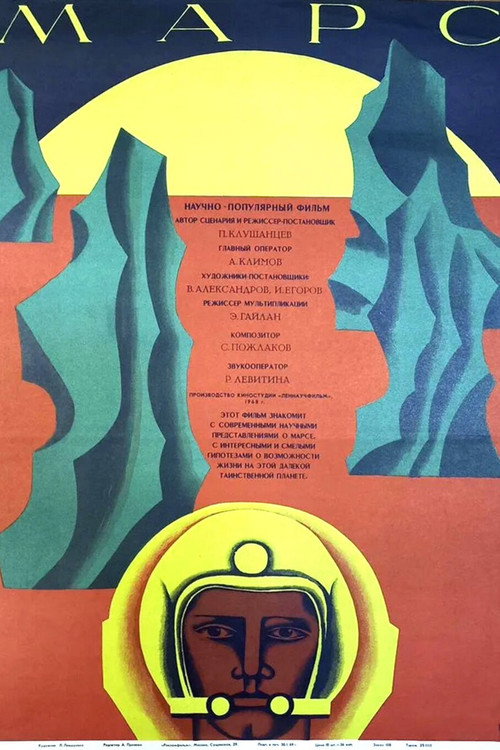
Mars (1968) serves more as a visual essay on planetary conditions than a character-driven drama. By prioritizing scientific inquiry and the mechanics of colonization, it lacks the traditional narrative structures needed for diverse interpersonal representation. The film's identity is rooted in a specific Soviet ideological framework. While it lacks diversity in gender and sexuality, it offers a unique cultural perspective by emphasizing collective scientific achievement over Western individualistic models. Ultimately, the work is a specialized technical exploration. Its diversity is limited by its documentary-style format and its focus on state-aligned scientific identity.
Category Breakdown
The film does not include any representations of LGBTQ+ identities. It focuses solely on scientific and biological themes, leaving no space for queer narratives.
The story centers on male-dominated scientific and exploratory roles typical of 1960s Soviet cinema. It does not challenge traditional gender hierarchies or give significant roles to women.
The cast reflects the demographic uniformity of Soviet state-sponsored missions. It does not use diverse casting to challenge the social constraints of the time.
The film presents a distinct departure from Western capitalist narratives by emphasizing progress through collective scientific endeavor. It prioritizes a secular, materialist worldview over religious frameworks.
There are no characters with visible or invisible disabilities portrayed with ability to act or used as plot devices.
Present on Screen
Limited or Absent
Official Synopsis
Like the previous film Luna produced by Klushantsev, the film Mars was created at the intersection of educational science films and science-fiction. It consists of seven pieces, which tell (based on scientific understanding of the 1960s) of the physical conditions on planet Mars, the possibility of life on Mars and what forms it might take, of Martian canals and "seas" of the Red Planet. In addition, the film includes the director's fantasy hypothetical forms of life on mars, and of the exploration and colonization of Mars in the near future.
1965

1955
1971
1957
2013

2014
2020

2020
No reviews yet. Be the first to share your thoughts on this movie!
Use the rating form above to leave a star rating and optional review.