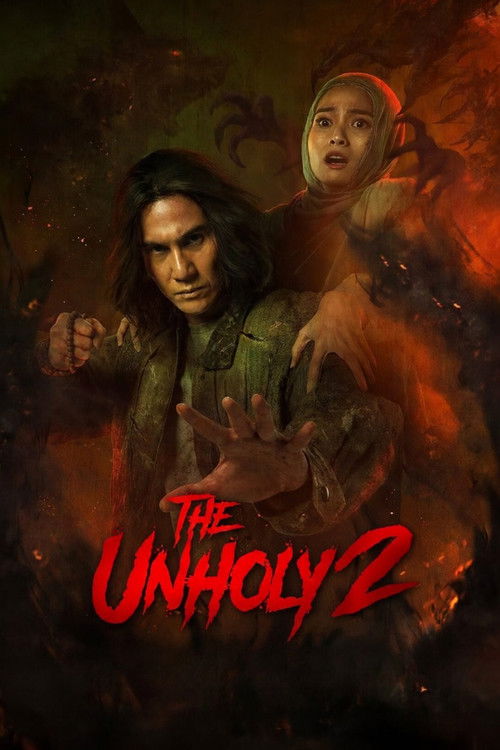
The Unholy 2
2025
No user ratings available yet
Representation score: 4.7 out of 10

Representation Score
Minimal
2026
Director
Charles Gozali
Runtime
101 minutes
Average Rating
No ratings yetNew Showbiz Analysis
The film opens with the intimate, hopeful announcement of Darsi’s pregnancy, a moment of domestic warmth that immediately contrasts with the violence to follow. This personal joy is shattered when thugs assault the couple, killing Darsi and her unborn child, establishing the film’s central argument: traditional family life is fragile against the brutality of unchecked power. The narrative then pivots to a broader conflict, where the village’s ancestral land is threatened by the “AN Company,” a developer whose legalistic aggression is juxtaposed against the shaman’s mystical authority. The sold meaning is clear: the film champions communal heritage and spiritual tradition over corporate modernity. The developer’s representatives, including the competent but ultimately powerless Arini, are framed as hollow agents of a system that values profit over people. In contrast, the villagers’ resistance, led by the shaman’s ritualistic magic, is portrayed as a legitimate and necessary defense of their way of life. The film’s internal logic, however, creates a tension: while it critiques the developer’s exploitation, it also relies on a patriarchal structure where the male protagonist, Darso, is the sole agent of retribution and resolution. Darsi’s death is the catalyst, but her voice is silenced, reduced to a memory that fuels Darso’s rage. The ending settles on a moral verdict that affirms the village’s traditional values. The corporate threat is neutralized, not through legal or political means, but through the restoration of spiritual order. This reinforces the film’s thesis that authentic cultural identity is the ultimate defense against external encroachment. Yet, the resolution is incomplete in its gender dynamics; while the village is saved, the personal loss of Darsi is never fully mourned or integrated into a new social order. The film celebrates the triumph of tradition but leaves the human cost of that tradition—embodied in Darsi’s death—unresolved, suggesting that the preservation of the collective comes at the expense of the individual, particularly the woman whose body was the site of the initial violence.
Category Breakdown
No queer characters or same-sex intimacy appear. The romantic focus remains exclusively on the heterosexual couple Darso and Darsi, with no non-binary identities present in the cast or dialogue.
Darsi dies in childbirth after thugs assault her, serving as the primary victim of patriarchal violence. While Arini displays competence, the narrative centers male authority figures like Darso and the shaman as the primary agents of resolution.
The cast and setting are entirely Indonesian, reflecting the film’s specific cultural context. No non-Indigenous or international characters are present to challenge or broaden the local demographic.
Traditional village rituals and communal land rights are positioned as morally superior to corporate exploitation. The developer’s “AN Company” is framed as the antagonist, while the shaman’s magic and villagers’ resistance are validated as legitimate forces.
No characters with physical, sensory, or cognitive disabilities are depicted. The supernatural elements involve ghosts and curses, not human impairment or neurodiversity.
Present on Screen
Limited or Absent
Official Synopsis
Darso, a clown busker, lost his wife and unborn child to thug violence. In grief, he brought his wife's body back to his village. However, the village is in chaos due to a conflict with an evil developer and a curse ritual that summons dark forces. Darso is also caught up in the evil forces connected to the person he loves most.
2025
2019
2023

2017

2022
2026

2024

2019
No reviews yet. Be the first to share your thoughts on this movie!
Use the rating form above to leave a star rating and optional review.