Heubodengeflüster
1967
No user ratings available yet
Representation score: 2.0 out of 10
Representation Score
Minimal
1967
Director
Finn Henriksen
Runtime
109 minutes
Average Rating
No ratings yetNew Showbiz Analysis
Life with Daddy offers a humorous take on the upheaval of traditional family dynamics. While it slightly shifts the usual gender roles by putting a man in a caretaking position, the film remains anchored in the social norms of the 1960s. The narrative centers around a traditional nuclear family and a homogeneous cast. The main conflict revolves around the absence of a female domestic worker, framing the home through the lens of service rather than genuine change. Overall, the film upholds conventional social structures while using role reversal as a comedic element.
Category Breakdown
The film portrays a traditional family where everyone is assumed to be straight and cisgender. There are no characters who challenge these assumptions.
The story challenges traditional gender roles by showing a man becoming a stay-at-home parent. However, this change is prompted by the departure of a woman who worked in the home.
The setting of the film is homogeneous, with no characters representing different racial backgrounds.
The story emphasizes the stability of a middle-class family life. It focuses on household routines rather than questioning social or religious institutions.
There are no characters with physical, mental, or neurodivergent disabilities in the film.
Present on Screen
Limited or Absent
Official Synopsis
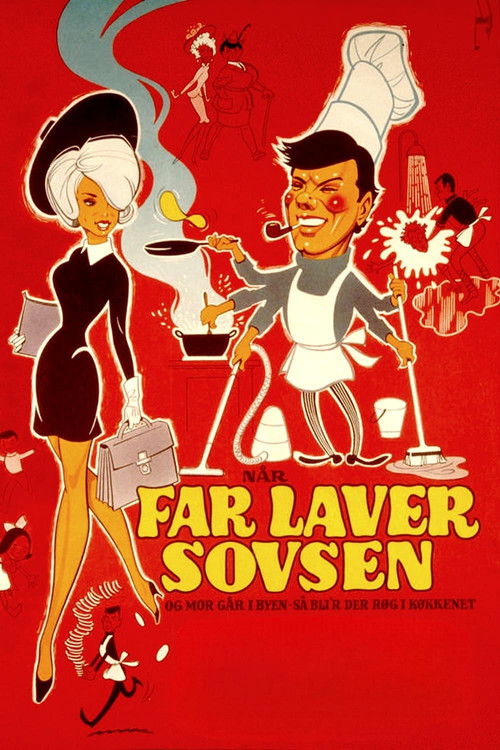
Herbert and Bitten live in a lovely house, happily married with two children. Herbert is a teacher at a secondary school, and he writes poetry in his spare time. Bitten is an engineer at a tie factory. Their home only functions thanks to their housekeeper, Mrs. Jørgensen. When Mrs. Jørgensen is confronted with her greatest fear—a live mouse—she leaves the home, never to return. Now there is only one thing to do: Herbert must give up his job and become a stay-at-home dad.
1967

1952

1962
1963

1960

1956
1964
1967
No reviews yet. Be the first to share your thoughts on this movie!
Use the rating form above to leave a star rating and optional review.