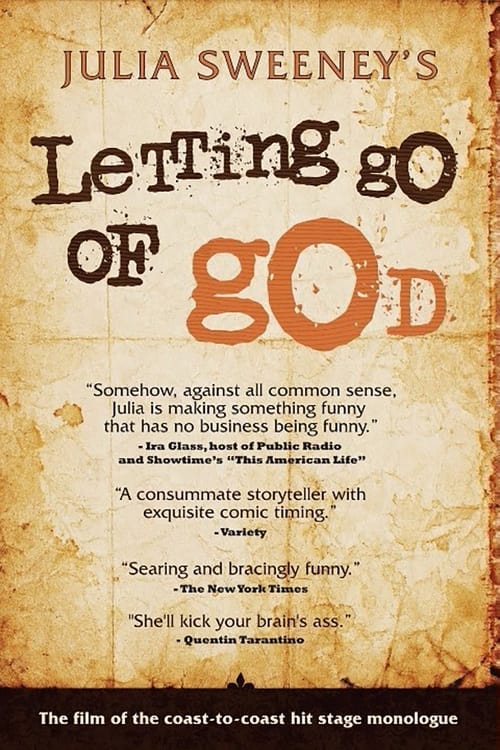
Julia Sweeney - Letting Go of God
2008
No user ratings available yet
Diversity score: 5.6 out of 10

1998
PG-13Director
Julia Sweeney
Runtime
85 minutes
Average Rating
No ratings yetSynopsis
Julia Sweeney tells the viewers the monologue about the hard time in her life when her brother fought with cancer and she was also diagnosed with a rare form of cancer.
Overall Score
Fair
Category Breakdown
LGBTQ+ Representation
The monologue focuses on personal medical trauma and individual spirituality. There is no explicit evidence of LGBTQ+ characters or narratives addressing non-heteronormative identities.
Gender Representation
The narrative is centered entirely on a female perspective. By centering a woman’s intellectual response to tragedy, the film disrupts structures that often relegate women to secondary roles.
Racial & Ethnic Diversity
The film maintains a singular, individualized focus. Without a diverse ensemble or multicultural setting, it does not actively integrate or represent diverse racial or ethnic perspectives.
Religious & Cultural Diversity
The film prioritizes secularism and subjective morality. It deconstructs traditional religious frameworks by portraying divine providence as a source of existential conflict rather than comfort.
Disability Representation
The narrative addresses chronic illness and cancer with significant agency. It uses medical diagnosis to drive philosophical interrogation rather than treating illness as a mere plot device.
Strengths
Areas for Improvement
AI Analysis
Julia Sweeney’s monologue is a deeply personal exploration of medical crisis and existential doubt. It succeeds by centering female agency and using physical suffering to challenge institutionalized religious frameworks. However, the work is highly individualized, which limits its demographic breadth. The focus on a singular perspective means it lacks representation for LGBTQ+ identities and diverse racial or ethnic groups. Ultimately, the film's strength lies in its progressive cultural framing and its refusal to use disability as a simple tool for inspiration, opting instead for a raw, philosophical inquiry.
2008

1992

2008

2012

2012

2016
2004

2017

1993

2018

2015

2019
No reviews yet. Be the first to share your thoughts on this movie!
Use the rating form above to leave a star rating and optional review.