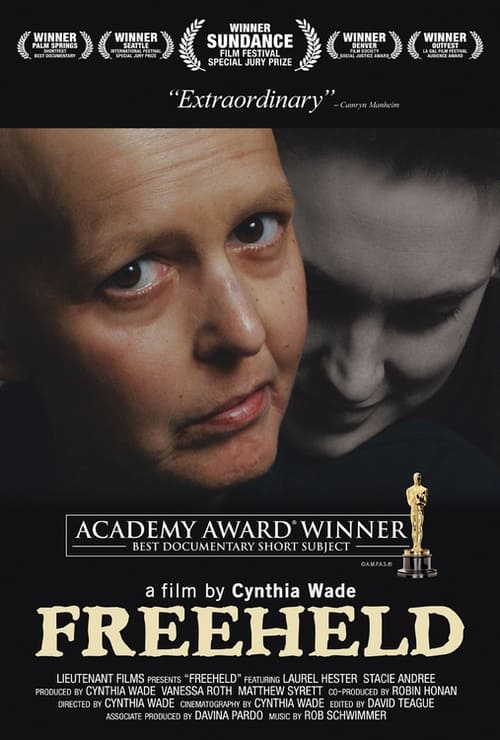
Freeheld
2007
No user ratings available yet
Diversity score: 7.4 out of 10

2008
Director
Agnieszka Piotrowska
Runtime
45 minutes
Average Rating
No ratings yetSynopsis
Imagine a world in which people seem hostile while inanimate objects appear friendly – even affectionate. Imagine dreading the touch of another human but longing for a passionate encounter with a large public structure. This is the strange world of the "objectum sexual"– a group of people, mainly women, whose intimate lives revolve around objects with which they say they share romantic and sexual love. Erika is married to the Eiffel Tower. She has a passion for inanimate objects, and her mission is to fight the stigma surrounding the disorder and create a global network of sufferers - like Amy, in love with a church organ, and Eija Riita, who married the Berlin Wall.
Overall Score
Good
Category Breakdown
LGBTQ+ Representation
The film explores objectum sexuality, a non-heteronormative orientation that disrupts conventional romantic understandings. It deconstructs heteronormative expectations of partnership by centering intimacy directed toward inanimate structures.
Gender Representation
The documentary focuses on women who deviate from traditional feminine archetypes. These subjects are portrayed as autonomous agents of their own desires rather than through domestic lenses.
Racial & Ethnic Diversity
The narrative appears focused on specific European landmarks and individuals. There is insufficient evidence to confirm a diverse racial cast within these geographic contexts.
Religious & Cultural Diversity
The film critiques social stigma and traditional structures. It prioritizes the subjective truth of individuals over established norms, validating experiences often categorized as deviant by Western institutions.
Disability Representation
The film engages with neurodivergence and unconventional psychological states. It avoids spectacle, though a tension exists between the subjects' self-actualization and clinical labels of disorder.
Strengths
Areas for Improvement
AI Analysis
Agnieszka Piotrowska’s documentary provides a deep dive into the fringes of social norms by examining objectum sexuality. It succeeds in centering the agency of individuals who exist outside traditional frameworks of human connection. The film excels at challenging heteronormative and gendered expectations. By focusing on women navigating unique identities, it moves beyond traditional relational roles to explore autonomous desire. However, the film lacks racial breadth, appearing geographically limited to European contexts. While it treats psychological states with dignity, the tension between personal identity and clinical categorization remains a complex layer.
2007
2015
2002

1999
2008

2010
2014

2012
2018
2017

1996

2016
No reviews yet. Be the first to share your thoughts on this movie!
Use the rating form above to leave a star rating and optional review.