
Goltzius & the Pelican Company
2012
No user ratings available yet
Diversity score: 4.0 out of 10
2008
Not RatedDirector
Peter Greenaway
Runtime
100 minutes
Average Rating
No ratings yetSynopsis
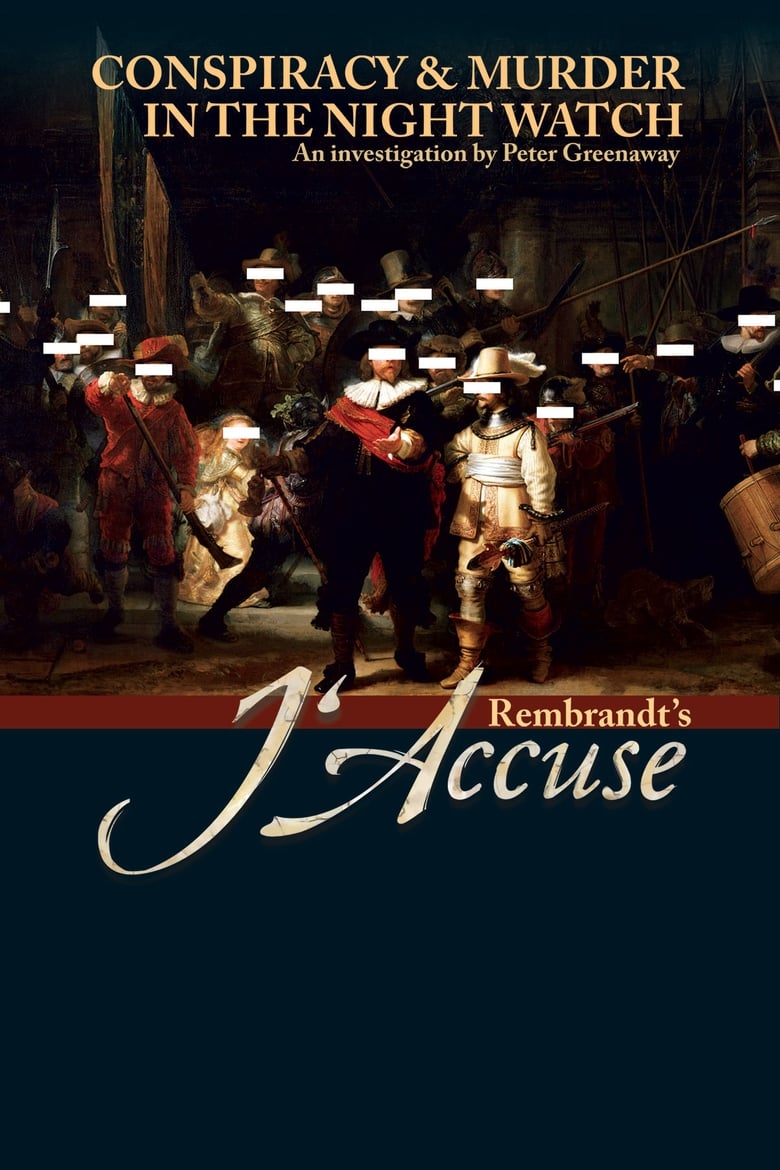
J'accuse is an 'essay-istic' documentary in which Greenaway's fierce criticism of today's visual illiteracy is argued by means of a forensic search of Rembrandt's Nightwatch. Greenaway explains the background, the context, the conspiracy, the murder and the motives of all its 34 painted characters who have conspired to kill for their combined self-advantage. Greenaway leads us through Rembrandt's paintings into 17th century Amsterdam. He paints a world that is democratic in principle, but is almost entirely ruled by twelve families. The notion exists of these regents as charitable and compassionate beings. However, reality was different.
Overall Score
Fair
Category Breakdown
LGBTQ+ Representation
The film functions as a visual essay rather than a character-driven narrative. It lacks explicit LGBTQ+ identities or romantic arcs, failing to center non-cisnormative identities within its forensic examination.
Gender Representation
Greenaway disrupts conventional expectations of the passive female subject. The film explores the psychological depth and systemic positioning of women within the 17th-century social hierarchy, avoiding decorative tropes.
Racial & Ethnic Diversity
The analysis is constrained by the historical subject matter of the Dutch Golden Age. It focuses on the predominantly Anglo-European merchant class of 17th-century Amsterdam without modernizing the demographic context.
Religious & Cultural Diversity
The film excels in critiquing traditional Western institutions. It dismantles the myth of the compassionate regent class, framing ruling families as a corrupt, self-serving oligarchy driven by greed.
Disability Representation
There is no discernible evidence regarding the representation of physical or neurodivergent disabilities within the film's formalist structure.
Strengths
Areas for Improvement
AI Analysis
Rembrandt's J'Accuse...! is an intellectual exercise that prioritizes historical deconstruction over modern identity politics. While it lacks contemporary representation of LGBTQ+ or diverse racial identities, it succeeds in subverting the traditional gaze through its analytical lens. The film's strength lies in its cultural critique, using Rembrandt's Nightwatch to expose the corruption of historical power structures. It moves beyond surface-level aesthetics to interrogate the systemic greed of the 17th-century elite. Ultimately, the work is a study of historical hierarchies rather than a showcase for diverse casting. It trades modern social representation for a sophisticated, skeptical interrogation of Western art and institutional power.
No reviews yet. Be the first to share your thoughts on this movie!
Use the rating form above to leave a star rating and optional review.