
The War Is Over
1989
No user ratings available yet
Representation score: 3.3 out of 10
Representation Score
Limited
1960
Director
Wolfgang Bellenbaum
Runtime
86 minutes
Average Rating
No ratings yetNew Showbiz Analysis
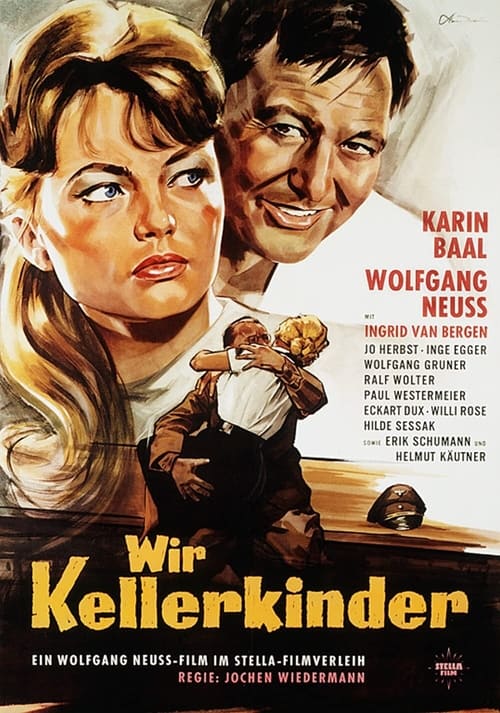
Wir Kellerkinder is a historical critique of institutional authoritarianism rather than a work of characters who reflect more than one aspect of diversity. It succeeds in challenging state-sanctioned culture by centering a protagonist whose identity is defined by resistance to ideological uniformity. The film's primary strength is its cultural commentary, specifically regarding the subversive nature of jazz. This provides a nuanced look at how individual expression clashes with rigid socio-political mandates. However, the film lacks breadth across gender, race, and LGBTQ+ spectrums. It remains largely tethered to the specific socio-political tensions of post-war German masculinity and political dissent.
Category Breakdown
The film lacks explicit LGBTQ+ characters or narratives. The story focuses on ideological conflicts regarding musical tastes and political affiliations rather than non-straight relationships.
The narrative centers on a male protagonist navigating male-dominated political and musical spheres. It does not provide evidence of systemic deconstruction of gender hierarchies or the elevation of women's roles.
Set within the geopolitical confines of mid-century Germany, the film focuses on internal European ideological struggles. It reflects the demographic homogeneity typical of regional storytelling from this era.
The film critiques authoritarian institutions by framing jazz as a subversive, 'other' cultural force. This disrupts monolithic national identity by prioritizing individualistic, non-conformist expression over state-driven morality.
The protagonist's eventual placement in an institution may stem from political non-conformity. However, it remains unclear if the film grants him a significant role in driving the story or uses institutionalization as a cliché of social failure.
Present on Screen
Limited or Absent
Official Synopsis
During the Third Reich, Macke played the drums for the Hitler Youth, but also had a "dangerous" penchant for jazz. After the war, he came under ideological fire in the Soviet zone. Finally in West Germany, he ends up in an institution.
1989
1962
1960
1986
1965
1970

1964
1943
No reviews yet. Be the first to share your thoughts on this movie!
Use the rating form above to leave a star rating and optional review.