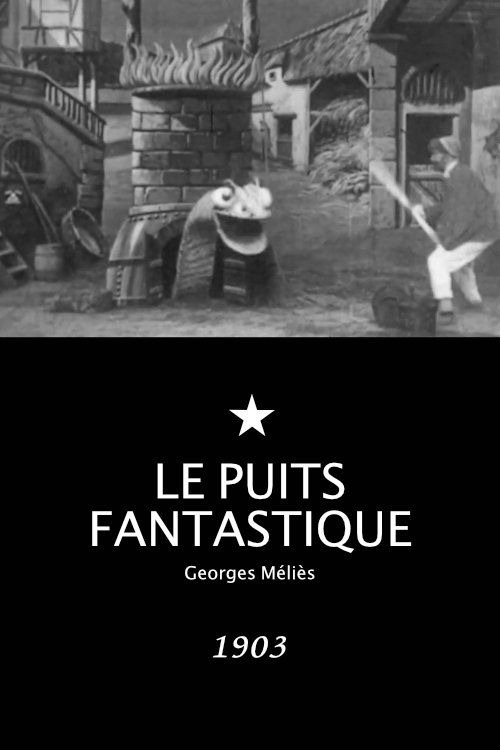
The Enchanted Well
1903
No user ratings available yet
Diversity score: 1.5 out of 10

1908
Director
Georges Méliès
Runtime
5 minutes
Average Rating
No ratings yetSynopsis
The opium fiend is seen in a den, puffing on this terrible narcotic. He then falls fast asleep and dreams that he is at home with his wife. He asks for something to drink and he is given wine, which he does not care for, and he is finally given some bottled beer and a glass, but he complains that the glass is too small and he gets a very large sized glass receptacle, into which his wife and maid servant pour the contents of the bottle. As he is about to drink the glass passes from his hand mysteriously, sailing through the room and out of the window to the moon…
Overall Score
Minimal
Category Breakdown
LGBTQ+ Representation
The film focuses entirely on a heteronormative domestic dreamscape. There is no presence of queer subtext or non-cisnormative identities.
Gender Representation
Female characters like the wife and maidservant act as passive facilitators of the protagonist's needs. The male lead maintains total agency, while women occupy subordinate, reactionary roles.
Racial & Ethnic Diversity
The cast appears homogeneous within this domestic vignette. There is no indication of racial blending or non-white casting in the narrative.
Religious & Cultural Diversity
The film uses opium consumption as a surrealist vehicle rather than a moral lesson. However, the setting reinforces traditional Western domesticity and nuclear family structures.
Disability Representation
The protagonist's addiction serves as a narrative device for dream-logic rather than a nuanced exploration of mental health. The condition lacks character agency.
Strengths
Areas for Improvement
AI Analysis
Méliès' short is a foundational work of cinematic surrealism that prioritizes visual spectacle over social complexity. The narrative relies on a dream-logic structure to explore sensory distortion, but it does so within a very narrow social framework. The film adheres strictly to the rigid hierarchies of the early 20th century. It presents a world where power dynamics are clearly defined by gender and domestic roles, offering little room for intersectional representation. While technically innovative for 1908, the work functions as a closed loop of traditional Western domesticity, using the protagonist's altered state merely as a plot engine for fantastical imagery.
1903
1905
1910
1898
1900
1903
1903
1903
1903
1904
1898
1908
No reviews yet. Be the first to share your thoughts on this movie!
Use the rating form above to leave a star rating and optional review.