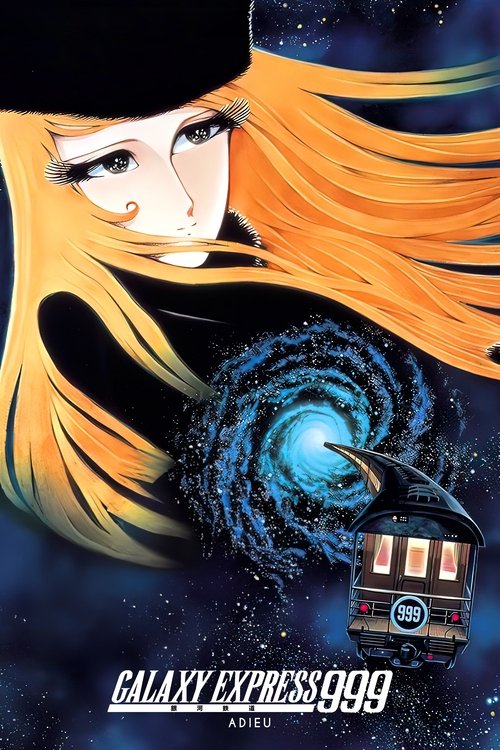
Adieu Galaxy Express 999
1981
No user ratings available yet
Representation score: 7.8 out of 10

Representation Score
Fair
1979
Director
Nobutaka Nishizawa, Shuuji Iuchi, Masayuki Akehi
Runtime
92 minutes
Average Rating
No ratings yetNew Showbiz Analysis
The film opens on a black screen detailing the "Great War," establishing a post-apocalyptic baseline where civilization has collapsed into stone. This visual silence sets the stage for a fable about the "human heart," where the Galaxy Express 999 serves as a moving sanctuary. The sold meaning is clear: mechanical enhancement is a hollow shell, and true warrior status is granted only through emotional submission to Maetel’s moral framework. Tetsuro, drawn with sharp, rugged lines, is initially coded as a selfish survivor, while Maetel, in her pristine white dress, represents an ethereal, untouched ideal. The camera lingers on her face during moments of revelation, treating her as the unshakeable moral center, while Tetsuro’s physical struggles are framed as the necessary cost of his moral education. The film’s argument pulls apart when it treats Tetsuro’s "masculine" traits—aggression and selfishness—as liabilities that must be corrected by feminine-coded virtues like empathy and sacrifice. The "warrior" is not the one who fights best, but the one who listens to the woman who defines what is right. This dynamic is reinforced by the visual language: antagonists like Count Mecha are drawn with grotesque, mechanical features, marking them as corrupted, while the leads retain a fairy-tale purity. The last image, holding on Tetsuro and Maetel’s faces as the train departs into the starry void, rewards their emotional bond over the mechanical journey. It is a verdict that prioritizes the soul over the body, positioning Maetel’s quiet wisdom as the ultimate power source in a world where technology has failed.
Category Breakdown
The narrative relies entirely on a heterosexual romantic bond between Tetsuro and Maetel. No same-sex intimacy, queer coding, or non-binary identity appears in the credits or plot.
Maetel functions as the moral center, guiding Tetsuro’s development through emotional wisdom rather than physical force. Tetsuro’s initial selfishness is framed as a flaw corrected by her influence, though she remains physically vulnerable and dependent on him for survival.
As an anime production, the film does not depict racial diversity. The "otherness" is defined by cyborg status and mechanical corruption rather than ethnic or racial difference.
The film critiques the "Great War" and technological dehumanization, valuing the "human heart" over mechanical efficiency. Traditional martial virtue is redefined as empathy and sacrifice, though the resolution relies on a singular, quasi-religious moral framework.
Tetsuro’s missing limbs are treated as a source of suffering and a marker of his past trauma. The "new body" is presented as a reward for moral growth rather than a neutral medical intervention, serving strictly as a plot device.
Present on Screen
Limited or Absent
Official Synopsis
A remake of episodes 12-13 of the TV series, the 999 arrives on a planet where the entire populace has been turned to stone. The one person still alive, a warrior, attacks Tetsuro and steals his pass, hoping to use it to escape and find a cure for his lover.
1981

1982
1979
1987
1977
2003

1988
1982
No reviews yet. Be the first to share your thoughts on this movie!
Use the rating form above to leave a star rating and optional review.