
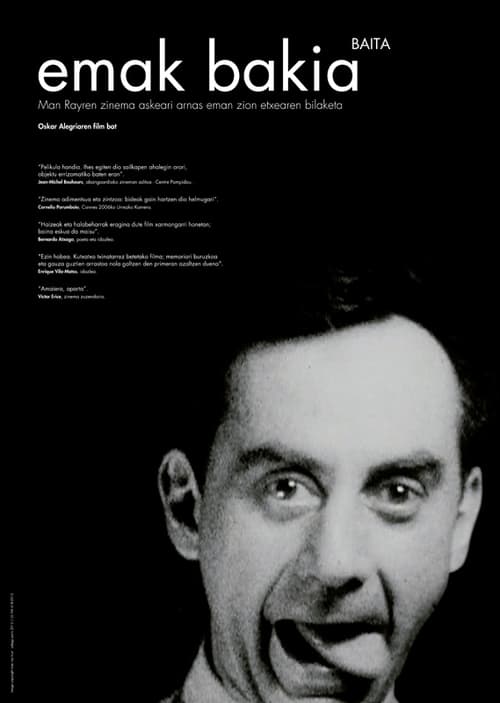
Emak-Bakia
1926
No user ratings available yet
Representation score: 0.1 out of 10
Representation Score
Fair
2012
Director
Oskar Alegria
Runtime
83 minutes
Average Rating
No ratings yetNew Showbiz Analysis
The film is a significant work of Philippine independent cinema that prioritizes sensory experience and historical interconnectedness. It succeeds by decentering Western cinematic pacing and offering a culturally grounded exploration of memory and place. While the documentary lacks explicit engagement with identity politics or the subversion of social hierarchies like gender or LGBTQ+ roles, it achieves high marks for its localized narrative structure. It effectively disrupts the expectation of Philippine cinema being filtered through an Anglo-centric perspective. Ultimately, the work functions as a cinematic pilgrimage. It bridges the gap between historical avant-garde art and contemporary landscapes through a contemplative, postmodern lens.
Category Breakdown
The film focuses on the relationship between art and geography but does not include any explicit LGBTQ+ character arcs or non-cisgender identities. The narrative remains neutral, emphasizing the search for a location over identity-driven commentary.
A maternal figure serves as the symbolic destination and narrative engine. However, the film lacks detailed character development to evaluate the subversion of gender hierarchies. The focus remains on landscape and historical legacy rather than deconstructing gender roles.
The documentary excels by authentically centering the Filipino experience. It avoids the Western gaze by using a predominantly Filipino cast and local landscapes. This approach presents a localized reality that gives high ability to act to regional inhabitants.
The film engages with the fluidity of history by linking 1920s avant-garde art to contemporary landscapes. Its contemplative, non-linear structure suggests a departure from Western, goal-oriented productivity in favor of a more wandering, subjective engagement.
There are no visible or invisible disabilities portrayed as central to the narrative. No characters with disabilities appear to be used as plot devices within the film.
Present on Screen
Limited or Absent
Official Synopsis
The documentary narrates the search for the house called Emak Bakia, near the coast of Lapurdi, where 83 years before the artist Man Ray made a picture where he set the rules for avant-garde cinema in the 1920s.
1926

1929

2002

2018

2006
2011
2000

2000
No reviews yet. Be the first to share your thoughts on this movie!
Use the rating form above to leave a star rating and optional review.