Find another title
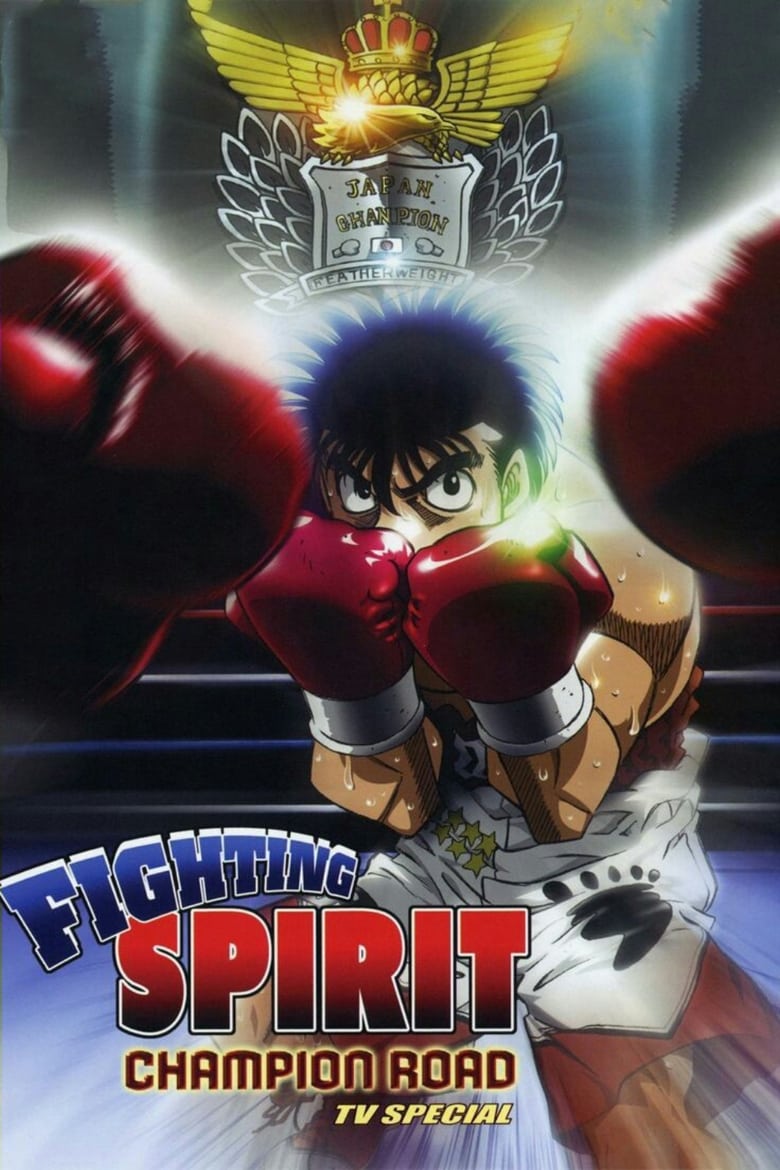
Fighting Spirit: Champion Road
2003
Director
Satoshi Nishimura
Runtime
90 minutes
Average Rating
No ratings yetSynopsis
Makunouchi Ippo is the new Featherweight champion of Japan and is now ready for his first title defense. His opponent, the former Jr. Featherweight champion and a medical student, Sanada Kazuki. In addition to this feud, Sanada is being coached by Kamogawa's former rival, Hama Dankichi. What makes things worse is that Sanada works at the same hospital where Kumi is a nurse at and everybody at the hospital wants Sanada to win. Not only does Ippo have to defend his title, he has to reclaim his love.
Where to Watch
Diversity & Representation
Overall Score
Limited
Category Breakdown
LGBTQ+ Representation
The narrative centers on heteronormative romantic tropes, specifically the protagonist's pursuit of Kumi. There is no evidence of non-cisnormative identities or critiques of traditional romantic structures.
Gender Representation
Agency is concentrated in male combatants, reinforcing traditional masculine archetypes of strength. Female characters like Kumi occupy supportive, secondary roles rather than driving the central conflict.
Racial & Ethnic Diversity
The story focuses on a localized Japanese boxing circuit, resulting in a culturally homogeneous cast. It lacks intersectional breadth or diverse casting elements.
Religious & Cultural Diversity
The film emphasizes traditional values like martial discipline and meritocracy. It operates within established social institutions without attempting to deconstruct or critique them.
Disability Representation
Characters are defined by peak physical performance. There is no indication of neurodivergence, chronic illness, or visible disabilities being used as narrative devices.
Strengths
- Provides a focused and disciplined study of athletic meritocracy and professional boxing culture.
- Offers a clear, high-stakes narrative centered on individual effort and martial training.
Areas for Improvement
- Lacks intersectional breadth, remaining culturally and racially homogeneous within its Japanese setting.
- Relies on traditional gender hierarchies where female characters occupy secondary, supportive roles.
- Does not engage with or represent diverse identities, including LGBTQ+ or disability perspectives.
AI Analysis
Fighting Spirit: Champion Road is a traditional sports-action piece that prioritizes individualistic achievement and athletic discipline. The narrative architecture is built around a meritocratic struggle for professional titles within a homogeneous Japanese setting. While the film provides a focused study of discipline and physical excellence, it adheres strictly to established social hierarchies. The power dynamics and character roles reinforce conventional gender and cultural norms rather than challenging them. Ultimately, the work functions as a genre-standard narrative. It lacks the intersectional breadth or identity-based disruption required to move beyond a narrow, traditional framework.
Rate this Movie
Reviews
No reviews yet. Be the first to share your thoughts on this movie!
Use the rating form above to leave a star rating and optional review.