
Moments Like This Never Last
2021
No user ratings available yet
Diversity score: 6.5 out of 10
2013
Director
Cheryl Dunn
Runtime
83 minutes
Average Rating
No ratings yetSynopsis
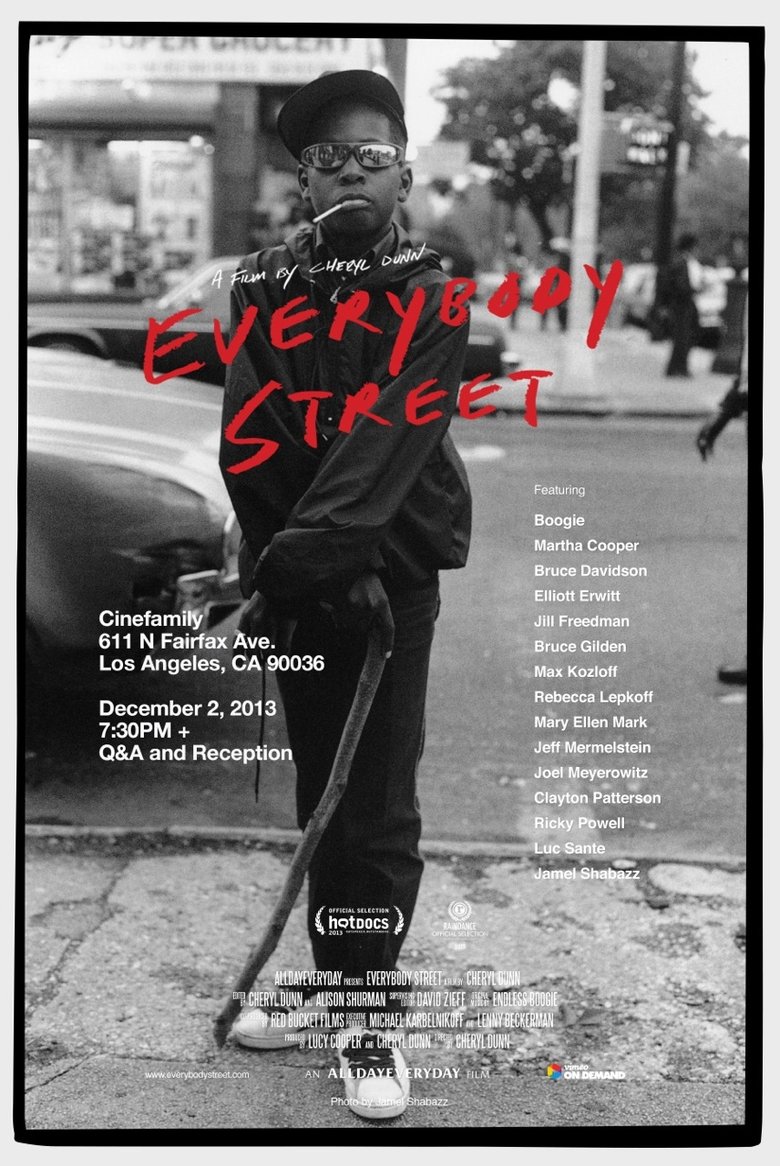
Celebrated filmmaker and photographer Cheryl Dunn turns her lens on the pioneers and masters of New York street photography. Dunn profiles artists spanning six decades, including Bruce Davidson, Mary Ellen Mark, Jill Freedman, Jeff Mermelstein and Martha Cooper, revealing that these shooters are as colourful and unique as the subjects they’ve relentlessly documented. Everybody Street explores the passion that compelled Freedman to spend years riding in squad cars during the most violent years in the city; Bruce Gilden’s drive to thrust his camera in people’s faces to capture a moment; and Martha Cooper’s dedication to chasing graffiti on passing subway cars in the Bronx. The film is a definitive look at the iconic visionaries of this often imitated art form.
Overall Score
Good
Category Breakdown
LGBTQ+ Representation
The film engages with non-normative social spaces through the lens of street photography. While it doesn't center LGBTQ+ narratives as a primary theme, it provides a platform for diverse identities.
Gender Representation
The documentary disrupts traditional hierarchies by centering female masters in a male-dominated field. It highlights the professional grit and autonomy of women like Mary Ellen Mark and Jill Freedman.
Racial & Ethnic Diversity
By focusing on the multi-ethnic fabric of New York City, the film validates diverse populations. Martha Cooper’s work in the Bronx highlights engagement with marginalized urban communities.
Religious & Cultural Diversity
The film prioritizes the truth of the captured moment over sanitized institutional perspectives. It frames artists as witnesses to systemic realities and the fringes of social order.
Disability Representation
There is no specific evidence regarding the portrayal of individuals with visible or invisible disabilities within the film's subjects or narrative.
Strengths
Areas for Improvement
AI Analysis
Everybody Street succeeds in deconstructing the traditional observer role by centering female pioneers in the field of street photography. By profiling women like Martha Cooper and Jill Freedman, the film challenges the historical male dominance of the genre. The documentary captures the chaotic, multi-cultural reality of urban life, using the camera to validate the agency of diverse populations. It moves beyond mere documentation to explore the passion and grit required to witness systemic urban realities. While the film excels in gender and cultural representation, it lacks explicit focus on LGBTQ+ narratives or disability representation. It remains a specialized study of artistic vision and urban friction.
2021
2015
2011
2005
2016

2013
2012
2005
2022
2017
2019
1996
No reviews yet. Be the first to share your thoughts on this movie!
Use the rating form above to leave a star rating and optional review.