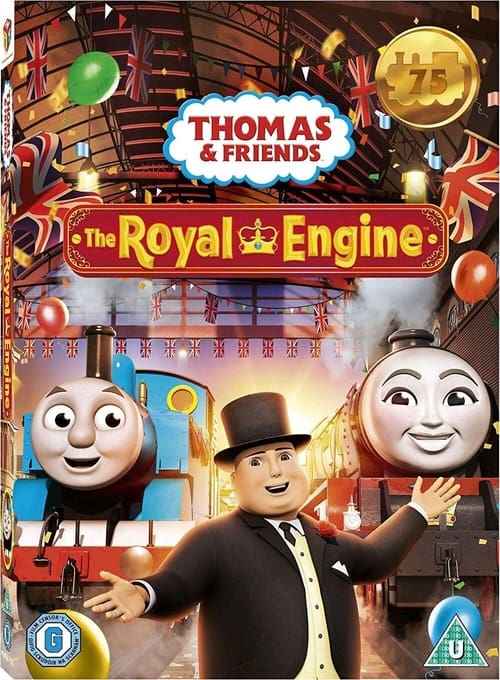
Thomas and Friends: The Royal Engine
2020
No user ratings available yet
Representation score: 0.9 out of 10
Representation Score
Minimal
2026
Director
Bronagh O'Hanlon
Runtime
30 minutes
Average Rating
No ratings yetNew Showbiz Analysis
The film opens with Thomas, a small blue tank engine, eager to prove his worth by handling extra work alone when Gordon needs assistance. This premise sells a straightforward meritocratic lesson: individual effort is valuable, but community is essential. The camera stays close to the engines’ faces and movements, treating their mechanical limitations and capabilities as the primary source of tension and humor. Henry Golding’s narration frames the story in a warm, paternal tone, guiding the audience toward a moral about interdependence rather than solitary heroism. The sold meaning is clear: work is noble, and asking for help is wise. Thomas’s initial decision to work alone is presented as a noble but flawed attempt at self-reliance, corrected by the realization that friends are necessary. The hierarchy among engines is gentle; Gordon, the larger and more powerful engine, is not portrayed as authoritarian but as a peer who also needs support. This flattens traditional power dynamics, suggesting that competence is not tied to size or status but to willingness to collaborate. Contradictions are minimal, as the film’s argument aligns with its internal logic. The “busy day” on Sodor serves as a test of both individual capability and collective spirit. The ending, implied by the overview, likely shows Thomas and his friends working together, reinforcing the idea that no engine is an island. The film does not challenge the fundamental nature of the railway system or the roles assigned to each engine; instead, it celebrates the existing structure while encouraging flexibility within it. In the context of 2026 preschool animation, the film offers a conservative but comforting vision of society. It avoids complex social issues, focusing instead on universal themes of friendship and labor. The lack of diversity in race, gender, and disability is not addressed or critiqued, reflecting the genre’s tendency to prioritize simplicity and moral clarity over representation. The last image, likely showing the engines together, affirms the value of community without questioning the boundaries of that community.
Category Breakdown
No same-sex intimacy or identity themes appear. The plot focuses on mechanical cooperation among engines, leaving non-heteronormative dynamics entirely absent from the narrative.
Female voices like Rosie appear but lack agency. The story centers on male engines proving competence through labor, relegating women to background or minor functional roles.
The narrative universe consists of anthropomorphic trains and minimal human voices. No racial or ethnic identities are depicted, discussed, or relevant to the plot’s conflict or resolution.
The film reinforces meritocratic and communal values. Thomas’s individual effort is validated, but the moral resolution prioritizes collective reliance on friends, keeping the system stable and cooperative.
No characters display physical, sensory, or cognitive impairments. The concept of help relates to workload distribution among engines, not disability accommodation or representation.
Present on Screen
Limited or Absent
Official Synopsis
When Gordon needs help, Thomas takes on extra work alone to prove himself. But a busy day on Sodor shows that even useful engines need their friends.
2020
2020
2003
2017
2021

2015
2011
2008
No reviews yet. Be the first to share your thoughts on this movie!
Use the rating form above to leave a star rating and optional review.