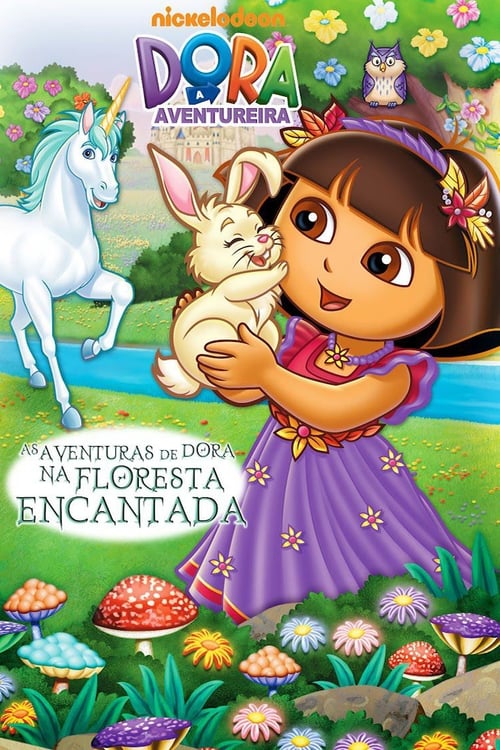
Dora the Explorer: Dora's Enchanted Forest Adventures
2011
No user ratings available yet
Representation score: 5.4 out of 10
Representation Score
Fair
2013
TV-YAverage Rating
No ratings yetNew Showbiz Analysis
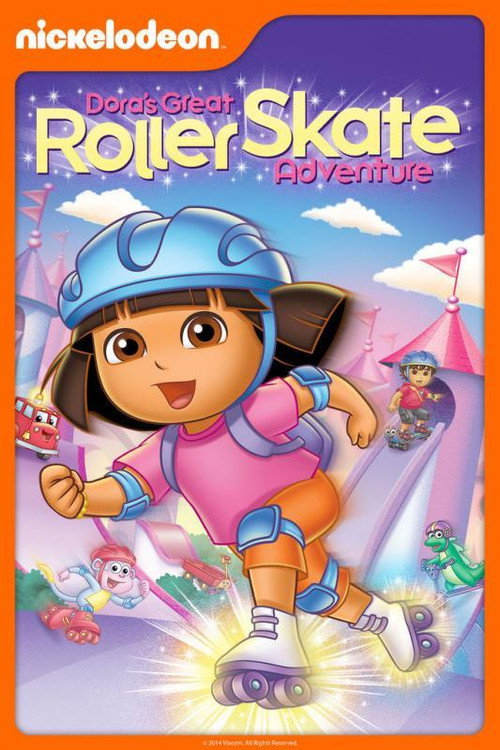
The film opens in a bright, static roller rink where Dora and Boots gaze at a pair of skates, a visual that immediately establishes the franchise’s direct-to-video aesthetic: saturated, safe, and pedagogical. This is not an adventure in the sense of danger, but a lesson in mechanical persistence. The sold meaning is clear: any child can succeed if they use the right tools and ask for help. Dora is the engine of the narrative, a brown-skinned Latina girl who solves problems through decision-making and cooperation, while Boots, the brown monkey, serves as her loyal but passive sidekick. The camera lingers on Dora’s expressions of determination, positioning her competence as the moral center of the story. The film’s argument is secular and meritocratic. There are no traditional hierarchies, no family obligations, and no religious overtures. Success is not granted by birth or innate talent but earned through the application of educational tools and social cooperation. This inverts the traditional Western default where male authority or natural genius drives the plot. Instead, the "rescue" is self-directed, relying on peer support and cognitive effort. Swiper the Fox provides the only friction, his failures played for slapstick rather than genuine threat, ensuring the moral remains unchallenged. The ending rewards this process. Dora and Boots celebrate after completing a skating trick, the final image affirming that persistence and the use of "tools" are superior to innate ability. The film does not shy away from its educational purpose; it tells the audience to "ask for help" and "use your brain," and the pictures show Dora doing exactly that. There is no contradiction between the stated copy and the sold meaning. The film is a polished construction of liberal values, where diversity is present in the lead’s phenotype but not explored as a source of conflict. It is a clean, untroubled vision of childhood agency, where the only failure is the refusal to learn.
Category Breakdown
Absent. The narrative focuses on childhood skill acquisition and friendship, with no depiction of same-sex intimacy, identity, or romantic dynamics.
Present. Dora serves as the sole competence center, driving the plot through decision-making and problem-solving while Boots functions as a passive sidekick. The film positions female agency as the default mode of success without requiring male validation.
Present. Dora is a brown-skinned Latina protagonist voiced by Eva Longoria, establishing a non-white lead as the normative hero. Her ethnicity is visible but treated as background context rather than a source of conflict or trauma.
Present. The film promotes secular, meritocratic values where success derives from effort, tools, and cooperation rather than innate talent or traditional hierarchy. Family structures are absent, and the moral framework centers on individual persistence and educational utility.
Absent. No characters display physical, cognitive, or sensory impairments. The roller skates function as recreational equipment rather than assistive devices, and no disabled life is depicted.
Present on Screen
Limited or Absent
2011
2006
2004
2006
2003
2015
1996
2017
No reviews yet. Be the first to share your thoughts on this movie!
Use the rating form above to leave a star rating and optional review.