Find another title
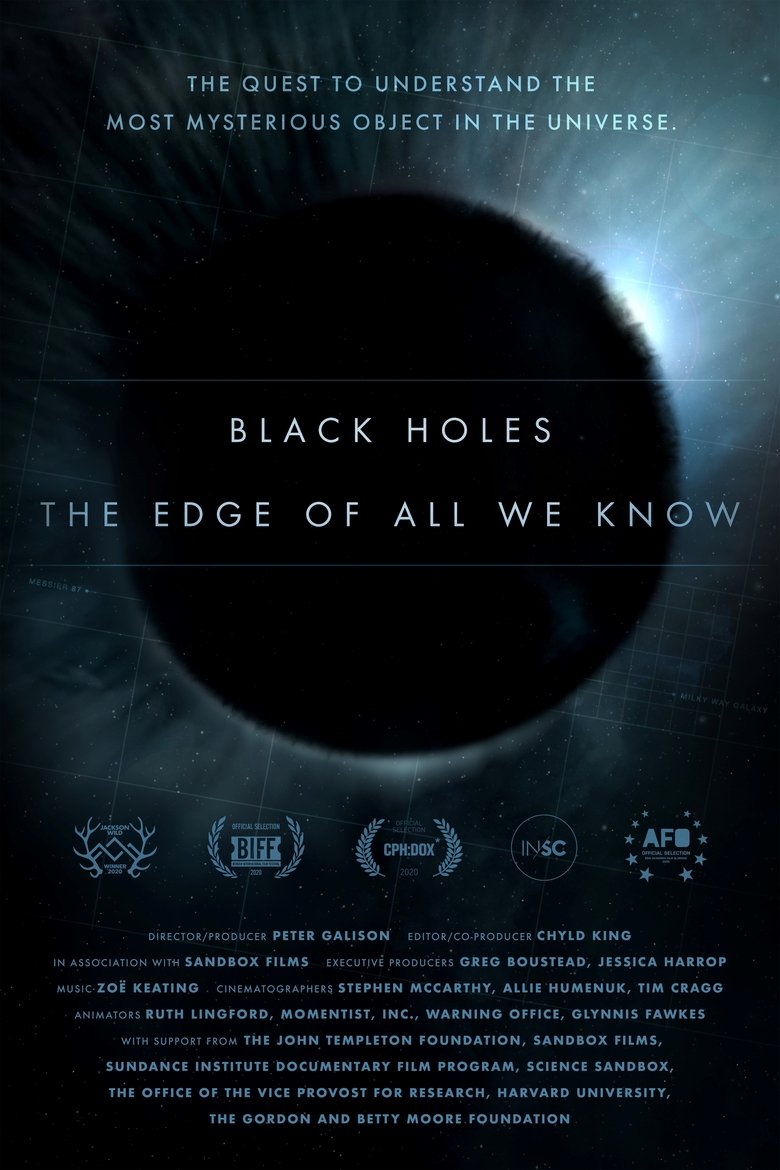
Black Holes: The Edge of All We Know
2020
Director
Peter Galison
Runtime
99 minutes
Average Rating
No ratings yetSynopsis
Black holes stand at the limit of what we can know. To explore that edge of knowledge, the Event Horizon Telescope links observatories across the world to simulate an earth-sized instrument. With this tool the team pursues the first-ever picture of a black hole, resulting in an image seen by billions of people in April 2019. Meanwhile, Hawking and his team attack the black hole paradox at the heart of theoretical physics—Do predictive laws still function, even in these massive distortions of space and time? Weaving them together is a third strand, philosophical and exploratory using expressive animation. “Edge” is about practicing science at the highest level, a film where observation, theory, and philosophy combine to grasp these most mysterious objects.
Where to Watch
Diversity & Representation
Overall Score
Good
Category Breakdown
LGBTQ+ Representation
The film maintains a neutral stance regarding sexual orientation and gender identity. It avoids heteronormative tropes but lacks explicit focus on queer narratives or non-cisnormative identities.
Gender Representation
Women are centered in high-level leadership and intellectual roles within the astrophysics community. The narrative avoids the absent female scientist trope by emphasizing their agency in the Event Horizon Telescope project.
Racial & Ethnic Diversity
The documentary presents a multi-ethnic scientific community that reflects a globalized landscape. By showcasing researchers from different continents, it challenges the idea of science as a Western-centric endeavor.
Religious & Cultural Diversity
The film prioritizes a secular, scientific worldview over religious frameworks. It frames scientific progress as a collective, international human endeavor rather than a nationalist or market-driven pursuit.
Disability Representation
The film does not feature characters with visible or invisible disabilities. The narrative focus remains strictly on the physics and philosophical implications of black holes.
Strengths
- Centers women in high-level leadership and intellectual roles within the astrophysics community.
- Highlights a multi-ethnic, globalized scientific community through the Event Horizon Telescope project.
- Challenges Western-centric scientific tropes by emphasizing international cooperation and collective human endeavor.
Areas for Improvement
- Lacks explicit representation or focus on LGBTQ+ identities and queer narratives.
- Does not feature characters with visible or invisible disabilities within the narrative arc.
AI Analysis
The documentary succeeds by presenting science as a borderless, collaborative effort. It moves away from the trope of the solitary, Western male genius, instead highlighting a diverse, internationalized community of researchers. By centering women in high-agency roles and showcasing a multi-ethnic cast, the film provides a modern, intersectional view of the professional scientific landscape. This approach makes diversity feel integrated rather than tokenized. While the film lacks specific representation regarding LGBTQ+ identities or disability, its emphasis on globalism and secular intellectualism provides a progressive framework for the subject matter.
Rate this Movie
Reviews
No reviews yet. Be the first to share your thoughts on this movie!
Use the rating form above to leave a star rating and optional review.