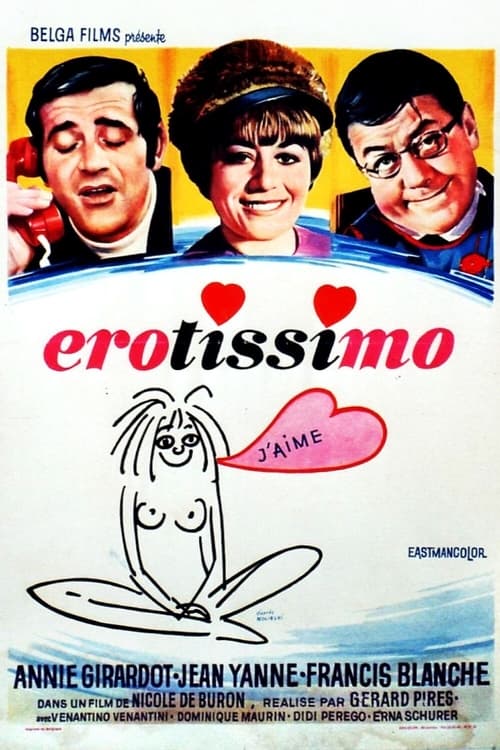
Erotissimo
1969
No user ratings available yet
Diversity score: 3.1 out of 10

1973
Director
Gérard Pirès
Runtime
91 minutes
Average Rating
No ratings yetSynopsis
He is a sales rep. She is a secretary. They live in the suburbs but she works in Paris. They don't see much of each other and spend much of their time in commuter trains. They try desperately to change job locations to be more often together, but... The plot is not the important thing in the film ; what makes it emblematic of the early and mid-seventies is the insouciant atmosphere. The '74 oil crisis had not yet morphed into a recession, and life was good - even though it was as hard as ever to find a home near one's workplace (or the reverse) ! Marthe Keller and Jacques Higelin are both excellent. The movie is not an all-time great, but it captures the "zeitgeist" of French life in the Seventies.
Overall Score
Limited
Category Breakdown
LGBTQ+ Representation
The film centers on a conventional romantic pairing between a male sales representative and a female secretary. It operates within traditional romantic frameworks without exploring non-cisnormative identities.
Gender Representation
While featuring an excellent female lead, the story remains anchored in 1970s gendered labor divisions. The narrative focuses on logistical struggles rather than subverting patriarchal hierarchies.
Racial & Ethnic Diversity
The film depicts a homogeneous social stratum typical of the era's suburban life. There is no indication of a non-white majority cast or diverse casting.
Religious & Cultural Diversity
The movie captures a specific moment of French insouciance and middle-class life. It prioritizes domestic stability over critiques of existing social or Western institutions.
Disability Representation
The narrative contains no mention of characters with visible or invisible disabilities.
Strengths
Areas for Improvement
AI Analysis
The film serves as a social mirror of 1970s France, capturing the zeitgeist of a period before the 1974 oil crisis. It focuses on the mundane, lived realities of a working couple navigating suburban life and commuter logistics. However, the work lacks active disruption of social hierarchies. It adheres to the era's traditional gender roles and presents a largely homogeneous view of French society, offering little representation for LGBTQ+ or non-white communities. Ultimately, the film is a period piece that reflects contemporary lifestyle and romantic logistics rather than challenging systemic social structures.
1969

1973
1974
1997
1984
1984

1963

1973

1981

1971

2003
1976
No reviews yet. Be the first to share your thoughts on this movie!
Use the rating form above to leave a star rating and optional review.