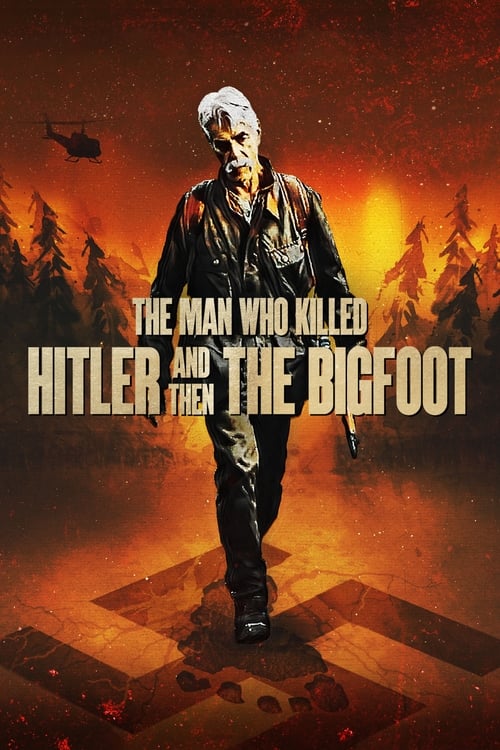
The Man Who Killed Hitler and Then the Bigfoot
2019
No user ratings available yet
Representation score: 2.7 out of 10
Representation Score
Minimal
2026
Director
Jason Mills
Runtime
74 minutes
Average Rating
No ratings yetNew Showbiz Analysis
The film opens with a grandfather showing his grandchild a Red Cross armband, framing the upcoming war story as a family legend passed down through generations. This domestic prologue sets the tone for a narrative that treats the horrors of World War II not as a geopolitical struggle, but as a shared human experience mediated by a mythical creature. The sold meaning is one of universal brotherhood: the American medic and the German medic, initially enemies, become allies in their mutual effort to heal the injured Bigfoot. The camera lingers on their cooperation, suggesting that the true enemy is not the opposing army, but the violence of war itself. The film’s argument is that compassion for the "other"—whether enemy soldier or mythical beast—is the highest moral imperative. This is reinforced by the subtitle excerpt, where the characters explicitly state, "Maybe they're just not like us," referring to the Bigfoot. The narrative logic pulls the war into a fable about coexistence, where the "secret mission" is less about defeating the enemy and more about understanding the land. The contradiction lies in the fact that the war is still deadly, with men dying from internal bleeding and mines, yet the film treats these deaths as tragic but secondary to the moral lesson of helping the creature. The ending, implied by the dialogue, settles on a quiet moral verdict: the survivors must leave, having overstayed their welcome, but they do so with a sense of duty fulfilled. The last image is not of victory, but of retreat, suggesting that the true win is the preservation of the forest and the recognition of shared humanity. The film’s values are clear: traditional military objectives are hollow, and the real mission is to heal, whether the patient is a soldier or a Bigfoot. This is a gentle, humanist take on the war genre, prioritizing empathy over ideology.
Category Breakdown
No queer characters, relationships, or dialogue appear. The cast consists entirely of male soldiers and a child, leaving LGBTQ+ representation absent from the narrative.
The narrative is exclusively male, featuring a young boy who serves only as a listener. Women are referenced only as domestic ideals, such as a wife’s roasted hen, or are absent from the battlefield.
The cast is visibly white, reflecting the historical context of the WWII setting. No non-white characters appear on screen or in the dialogue, and the "other" is represented solely by the non-human Bigfoot creatures.
The film frames the war as a "secret mission" where enemy and ally medics bond over shared humanity. Traditional military hierarchy is subordinated to a moral imperative to help the "other," treating the conflict as a misunderstanding rather than a moral struggle.
No characters are depicted with physical, sensory, or cognitive disabilities. The focus remains on combat injuries and survival, leaving disability representation absent from the on-screen inventory.
Present on Screen
Limited or Absent
Official Synopsis
When his platoon is ambushed during WWII, an American medic escapes into the nearby forest, relentlessly pursued by the enemy. While evading capture, he encounters an unbelievable creature, not knowing if it's friend or foe. It will take everything he has to survive as new alliances will be formed and loyalties will be tested.
2019
2021
2022

2012
2014
2010

2025

2014
No reviews yet. Be the first to share your thoughts on this movie!
Use the rating form above to leave a star rating and optional review.