Find another title
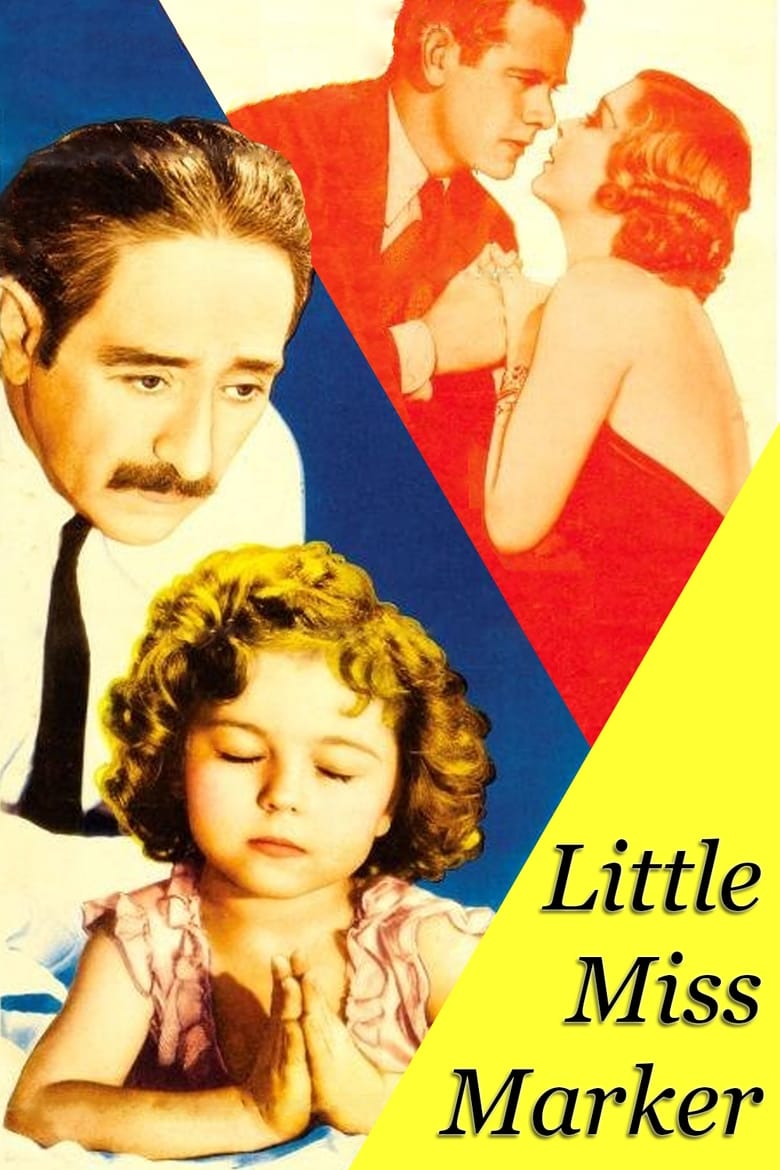
Little Miss Marker
1934
Director
Alexander Hall
Runtime
79 minutes
Average Rating
No ratings yetSynopsis
Big Steve Halloway, gambler and proprietor of New York's Horseshoe Cabaret, is in desperate need of money. He arranges for his fellow bookies, especially Sorrowful Jones, to each pay him $1,000 for his racehorse, Dream Prince, to lose. With all bets being placed at the window, Sorrowful encounters a gambler, having lost $500, wanting to place his bet but unable to come up with $20. Instead, he places his little girl, Marthy Jane, as security, or in bookie's terms a "marker". "Marky", as she comes to be known, winds up under the care of Sorrowful Jones and his lady friend, singer Bangles Carson.
Where to Watch
Diversity & Representation
Overall Score
Limited
Category Breakdown
LGBTQ+ Representation
The film contains no discernible LGBTQ+ characters or non-cisnormative identities. Interpersonal dynamics remain strictly within the conventional romantic and platonic structures of the 1930s.
Gender Representation
Marthy Jane disrupts traditional hierarchies by providing agency within a hyper-masculine gambling environment. She acts as a catalyst for male reform, though the film maintains traditional romantic pairings.
Racial & Ethnic Diversity
The cast reflects the homogeneous demographic norms of 1934 cinema. The narrative lacks racial diversity and does not engage with non-Anglo-Saxon perspectives or diverse casting.
Religious & Cultural Diversity
The film displays pre-Code moral relativism by treating gambling as a comedic backdrop rather than a sin. It operates within existing socioeconomic frameworks without critiquing Western institutions.
Disability Representation
There are no visible or invisible disabilities portrayed as central to character arcs. No characters with disabilities are utilized as plot devices.
Strengths
- The child protagonist, Marthy Jane, provides a subversion of gendered competence by driving the narrative.
- The film avoids rigid, singular Christian morality by framing gambling through a lens of moral relativism.
Areas for Improvement
- The film lacks racial diversity, presenting a culturally monolithic depiction of the gambling world.
- There is no representation of LGBTQ+ identities or non-cisnormative gender expressions.
- The narrative fails to include characters with visible or invisible disabilities.
AI Analysis
Little Miss Marker is a product of its era, functioning within the demographic homogeneity typical of early 1930s studio productions. While it offers a minor subversion of gendered agency through its child protagonist, it lacks systemic complexity. The film's world is culturally monolithic, focusing on a New York gambling circuit that lacks racial or intersectional depth. It avoids rigid moralism through its pre-Code setting but does not challenge the status quo. Ultimately, the film's diversity is limited by its historical context, providing a narrow view of social identity and representation.
Rate this Movie
Reviews
No reviews yet. Be the first to share your thoughts on this movie!
Use the rating form above to leave a star rating and optional review.