
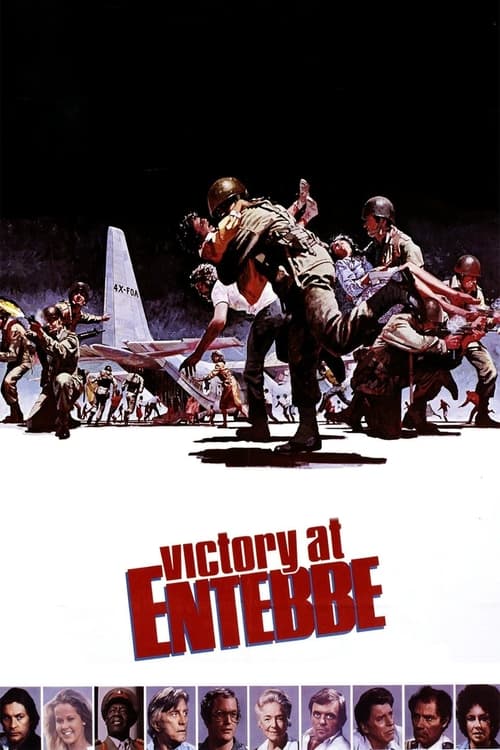
Raid on Entebbe
1976
No user ratings available yet
Representation score: 0.8 out of 10
Representation Score
Minimal
1976
UnratedDirector
Marvin J. Chomsky
Runtime
119 minutes
Average Rating
No ratings yetNew Showbiz Analysis
Victory at Entebbe is a traditional historical procedural that emphasizes military precision and geopolitical tension over social issues. The film relies on a clear moral distinction between state legitimacy and the illegitimacy of the hijackers. By reinforcing established power structures and conventional gender roles, the film functions as a traditional cinematic work. It avoids challenging social hierarchies or exploring diverse identities, focusing instead on the mechanics of a military operation.
Category Breakdown
The film does not include any representation of non-binary gender identities or queer narratives. It follows the social norms of its 1976 production era closely.
Male military and political figures hold the majority of narrative ability to act. Women play secondary, passive roles as hostages or family members, serving mainly as emotional stakes.
The cast is predominantly white, featuring Israeli officials. While Palestinian hijackers and Ugandan officials appear, they fit within a typical good-versus-evil framework.
The story operates within a framework of Western and state-centric morality. It portrays the Israeli military response as a legitimate action against terrorism.
The film does not feature any characters with visible or invisible disabilities. Disability is not used as a character-driven element within the narrative.
Present on Screen
Limited or Absent
Official Synopsis
The film is based on an actual event: Operation Entebbe and the freeing of Israeli hostages at Entebbe Airport (now Entebbe International Airport) in Uganda.
1976
2019
1977
2017
2018
2016
1988
1990
No reviews yet. Be the first to share your thoughts on this movie!
Use the rating form above to leave a star rating and optional review.