Find another title
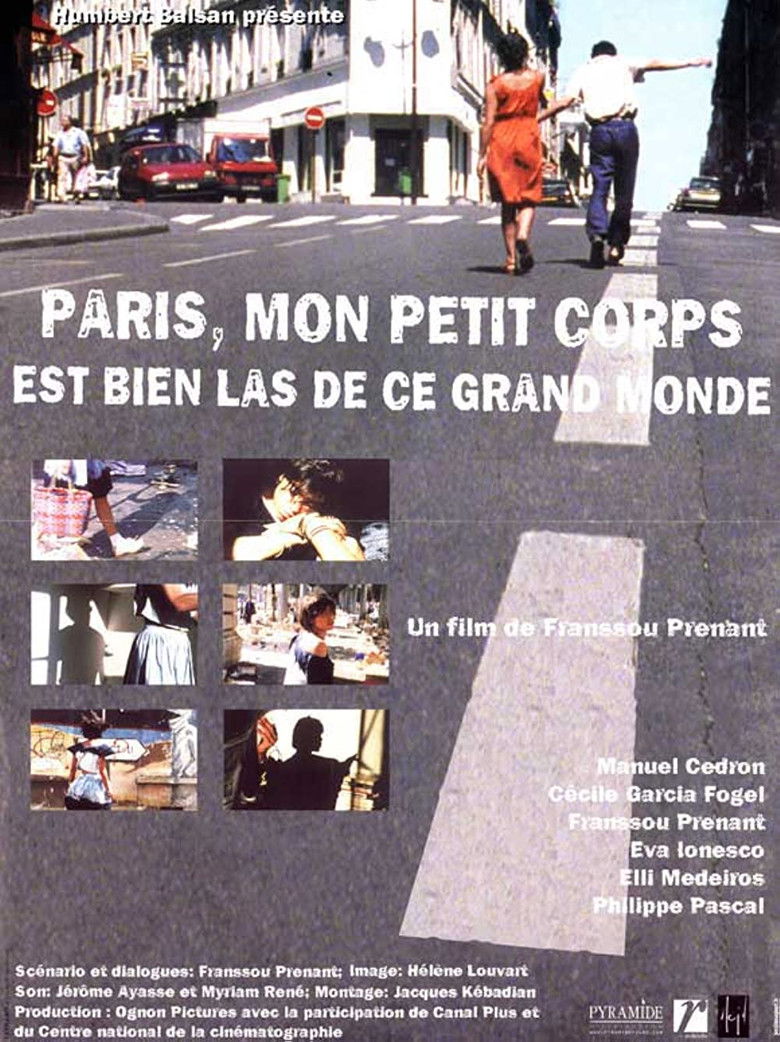
Paris, My Little Body Is Very Tired of This Big World
2000
Director
Franssou Prenant
Runtime
108 minutes
Average Rating
No ratings yetSynopsis
Lunettes and Myope: two ways of resisting the world. Identical and opposites, face to face or, more often, back to back, in a small room in a timeless space. Twins and adversaries, these two girls make one: Lunettes uses her glasses to help her understand the world, or at least accept it; Myope can't see, except within herself, and lost in her blurred, but sharp, experience of the world, rebels continuously. Incited by Lunettes, Myope creates (in the same city and climate, but in another dimension) two characters: Pierrot and Agathe. To a certain degree, these two are a disjointed response to Myope, Lunettes, neighbors, and distant representatives. It's very hot. The inhabitants are interested in fountains and shadows. They build cool cabins, hanging curtains over the balcony balustrades. Asphalt sticks to the soles of sandals and when the wind blows, the canopies flap above the café terraces.
Where to Watch
Diversity & Representation
Overall Score
Fair
Category Breakdown
LGBTQ+ Representation
The film explores a symbiotic, intense relationship between two female protagonists. While romantic orientation is not explicitly stated, their blurred boundaries and emotional interdependence suggest a narrative that prioritizes queer-coded intimacy.
Gender Representation
The narrative centers entirely on female subjectivity and agency. The protagonists exist independently of men, using characters like Pierrot and Agathe as psychological extensions of the female experience rather than traditional archetypes.
Racial & Ethnic Diversity
The setting emphasizes sensory atmosphere and a timeless space over specific demographic markers. There is no explicit evidence of a diverse cast within the provided narrative description.
Religious & Cultural Diversity
The film favors an existential, secularist worldview over traditional institutional values. It prioritizes internal experience and subjective morality, creating an alternate dimension that critiques external societal pressures.
Disability Representation
The story offers a sophisticated look at sensory disability. By framing visual impairment as a source of creative agency rather than an obstacle, it avoids common tropes and validates unique ways of knowing.
Strengths
- Sophisticated exploration of sensory disability and neurodivergence.
- Strong centering of female subjectivity and agency.
- Avoids 'inspiration porn' by treating disability as a valid mode of perception.
Areas for Improvement
- Lacks explicit evidence of racial or ethnic diversity.
- LGBTQ+ representation remains ambiguous and potentially only queer-coded.
AI Analysis
The film excels at centering marginalized sensory experiences and female subjectivity. By focusing on the internal psychological landscapes of its protagonists, it disrupts conventional narrative expectations through a surrealist lens. However, the work lacks explicit evidence regarding broad racial or LGBTQ+ diversity. The focus remains heavily on the interpersonal and sensory dynamics of the two main characters. Ultimately, the film provides a progressive alternative to traditional cinema by deconstructing reality and prioritizing internal agency over mainstream, commercially driven storytelling.
Rate this Movie
Reviews
No reviews yet. Be the first to share your thoughts on this movie!
Use the rating form above to leave a star rating and optional review.