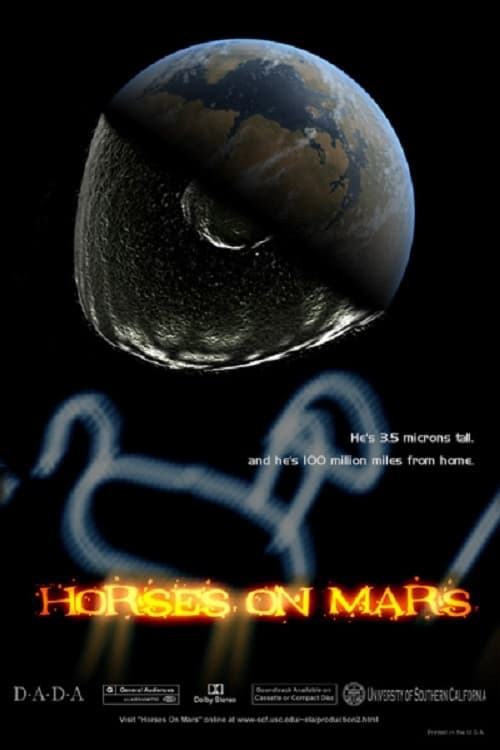
Horses on Mars
2001
No user ratings available yet
Diversity score: 3.8 out of 10

2014
Director
Erik Wernquist
Runtime
4 minutes
Average Rating
No ratings yetSynopsis
This short film visualizes potential human exploration of the Solar System through a sequence of digitally reconstructed environments based on real astronomical data and spacecraft imagery. Depicting locations such as Mars, the moons of Saturn and Jupiter, and other celestial bodies, it presents speculative human activity grounded in existing scientific ideas, accompanied by narration from Carl Sagan’s "Pale Blue Dot".
Overall Score
Fair
Category Breakdown
LGBTQ+ Representation
The film's aesthetic relies on silhouettes and vast landscapes, which precludes the depiction of specific romantic or gender-based identities. No LGBTQ+ characters or narratives are present.
Gender Representation
Humanity is presented as a collective, mechanized entity rather than a collection of individuals. This avoids traditional gender hierarchies but lacks active subversion of gender roles through character agency.
Racial & Ethnic Diversity
Characters are depicted through mechanical augmentations and silhouettes, deconstructing racial signifiers. This post-human visual language avoids stereotypes but lacks intentional, diverse characterization.
Religious & Cultural Diversity
The film prioritizes a secular, scientific worldview over religious or nationalistic frameworks. Using Sagan’s text promotes cosmic unity that transcends Western-centric or capitalist competition.
Disability Representation
Survival is predicated on technological integration and mechanical suits. While this avoids 'inspiration porn,' the film lacks specific character-driven agency regarding neurodivergence or chronic illness.
Strengths
Areas for Improvement
AI Analysis
Wanderers functions as a visual meditation on human expansion, shifting the focus from individual identity to the collective movement of the species. By utilizing Carl Sagan’s 'Pale Blue Dot' narration, the film adopts a cosmic perspective that prioritizes scientific speculation over interpersonal social dynamics. The narrative architecture disrupts conventional drama by replacing individual identity with a species-wide journey. This approach allows the film to bypass traditional social hierarchies and the pitfalls of tokenism through a postmodern, universalist lens. Ultimately, the work remains a neutral, scientifically-grounded exploration. It achieves a form of universalism but does not actively engage in the intentional subversion of social identities required for a higher progressive score.
2001

2010

2017

2013
2016

2016
2019
2011
2017
1965

2011

2001
No reviews yet. Be the first to share your thoughts on this movie!
Use the rating form above to leave a star rating and optional review.