Find another title
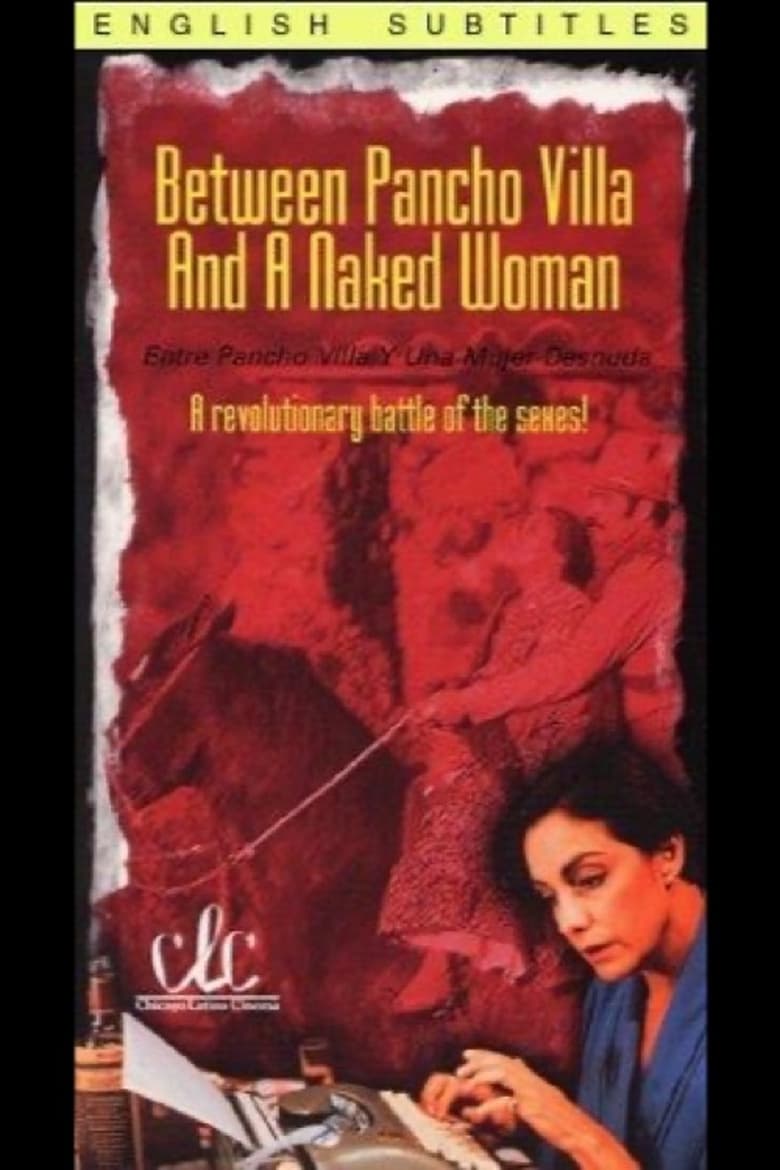
Between Pancho Villa and a Naked Woman
1996
Director
Sabina Berman, Isabelle Tardán
Runtime
87 minutes
Average Rating
No ratings yetSynopsis
Gina is a modern business woman in her late forties, she has a lover named Adrian, who she sees once in a while just to have sex; they are both atracted to the historic figure of Pancho Villa, while he admires his power, she admires his virility. As Gina helps Adrian (who is a journalist) to write a book about Pancho Villa, she discovers the similarity between Villa's relation to women to that of Adrian and hers. She gets sick of only having sex, and when she decides to get married with him and have a baby, he escapes to buy cigarrettes and gets lost for three months. Gina forgets about him and gets a new boyfriend (half the age she is), and when Adrian tries to get her back and she refuses him and humiliates him, the one and only Pancho Villa appears as his machista conscience ready to do anything to get Gina back.
Where to Watch
Diversity & Representation
Overall Score
Good
Category Breakdown
LGBTQ+ Representation
The film explores non-traditional relationship structures through a connection defined by sexual utility rather than domesticity. However, explicit LGBTQ+ identities are not a central focus of the narrative.
Gender Representation
The story centers on Gina, a female protagonist who uses her intellectual agency to critique masculine archetypes. It actively deconstructs machismo by positioning the female perspective as the primary lens of truth.
Racial & Ethnic Diversity
As a Mexican production, the film maintains a culturally specific identity. It avoids common Western whitewashing by centering the Mexican experience and its internal social complexities.
Religious & Cultural Diversity
The narrative critiques traditional patriarchal institutions and the 'great man' theory of history. It frames historical revolutionary movements as flawed due to the systemic exclusion of women.
Disability Representation
There is no discernible evidence regarding the portrayal of physical or neurodivergent disabilities within the provided material.
Strengths
- Strong gender subversion through a female protagonist who critiques masculine power.
- Authentic cultural centering that avoids the whitewashing of Mexican history.
- Sophisticated critique of patriarchal structures and the 'great man' theory of history.
Areas for Improvement
- Lack of explicit LGBTQ+ representation or identity-focused narratives.
- No discernible evidence regarding the inclusion of characters with disabilities.
AI Analysis
The film functions as a sophisticated deconstruction of historical and social hierarchies. By using Pancho Villa as a symbol of patriarchal dominance, it challenges how traditional power structures marginalize female agency. Rather than a standard historical epic, the work offers a nuanced study of identity. It juxtaposes historical fantasy with contemporary realism to critique the machismo inherent in both revolutionary history and modern interpersonal dynamics. While the film excels in gender subversion and cultural specificity, it lacks explicit representation of LGBTQ+ identities or disability-related narratives.
Rate this Movie
Reviews
No reviews yet. Be the first to share your thoughts on this movie!
Use the rating form above to leave a star rating and optional review.