Find another title
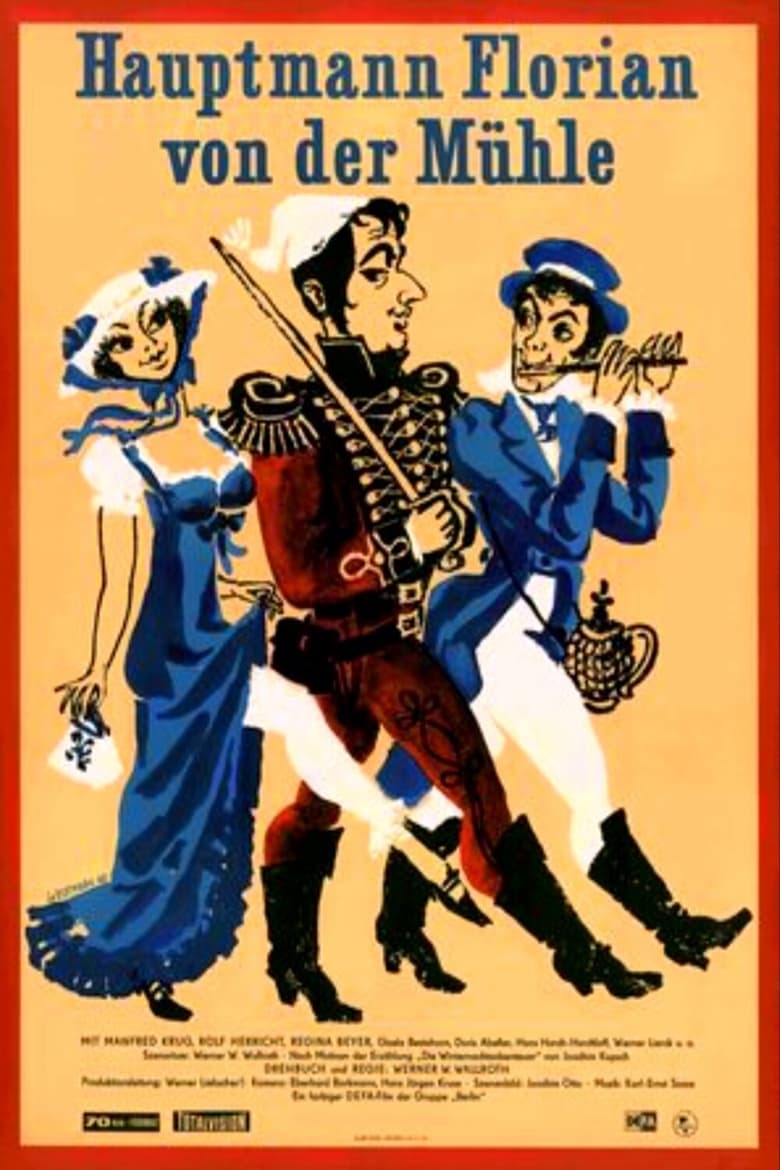
Hauptmann Florian von der Mühle
1968
Director
Werner W. Wallroth
Runtime
132 minutes
Average Rating
No ratings yetSynopsis
This story of the miller Florian, who gave all his money to the war against Napoleon, is loosely based on a true story. After the war, Florian's reimbursement is challenged, and he must also pay taxes on his destroyed mill. He resists the tax collectors and takes off to Vienna, where he intends to defend his rights. On the way, he rescues the Duchess of Guastalla from assault. She also wants to go to Vienna, as His Majesty Franz II is trying to contest an heir in her favor. With cunning, luck, and dagger, Florian fights his way through a slew of nobility and their secret police.
Where to Watch
Diversity & Representation
Overall Score
Fair
Category Breakdown
LGBTQ+ Representation
The story follows a traditional romantic trajectory between Florian and the Duchess. There is no evidence of non-cisnormative identities or narratives that critique heteronormativity.
Gender Representation
The Duchess of Guastalla possesses political agency by contesting an heirship. However, the plot remains driven by Florian's traditional masculine hero's arc.
Racial & Ethnic Diversity
Set in Napoleonic-era Europe, the film centers on a homogeneous Western European cast. No non-white characters are shown in positions of agency.
Religious & Cultural Diversity
The narrative critiques Western institutions by framing the conflict as a struggle against corrupt nobility and state-sanctioned taxation. This challenges established power structures.
Disability Representation
The film contains no mention of characters with visible or invisible disabilities.
Strengths
- The Duchess of Guastalla provides a degree of political agency and subverts traditional hierarchies.
- The plot offers a critique of systemic institutional oppression and corrupt state authority.
Areas for Improvement
- The film lacks intersectional complexity and non-normative identity portrayals.
- The narrative centers on a homogeneous Western European cast with little racial diversity.
- The story follows a traditional masculine hero's arc rather than exploring diverse gender dynamics.
AI Analysis
The film functions primarily as a traditional historical adventure set during the Napoleonic era. While it provides the female lead with significant political stakes, the narrative remains anchored in conventional tropes. It offers a moderate critique of institutional authority, focusing on an individual's struggle against systemic oppression. However, the lack of intersectional complexity and diverse casting limits its progressive impact. Ultimately, the film relies on classic gendered dynamics and a homogeneous cast, making it a standard period piece rather than a diverse narrative.
Rate this Movie
Reviews
No reviews yet. Be the first to share your thoughts on this movie!
Use the rating form above to leave a star rating and optional review.