
BECK
2010
No user ratings available yet
Representation score: 3.5 out of 10
Representation Score
Good
2003
Director
Takanori Jinnai
Runtime
105 minutes
Average Rating
No ratings yetNew Showbiz Analysis
Rockers succeeds in challenging social and gendered expectations by focusing on youth rebellion and the deconstruction of domestic authority. It moves away from traditional patriarchal leadership in favor of individualistic, subcultural expression. However, the film lacks significant racial and LGBTQ+ breadth. The narrative remains localized within a specific cultural milieu, limiting its multi-layered depth. Ultimately, the film functions as a mid-range entry that excels at challenging institutional stability through its messy, unpolished character studies.
Category Breakdown
The film explores sexual repression through Ko-chan, whose past experiences serve as a metaphor for identity struggles. However, it does not explicitly show queer romantic relationships or diverse gender identities.
The film portrays male characters as emotionally vulnerable and physically reactive to stress, challenging traditional notions of masculinity. Characters like Ko-chan and Gaku-chan are shown as emotionally volatile rather than stoic.
As a Japanese production focused on a specific musical subculture, the cast is largely homogeneous. The film does not include diverse ethnic backgrounds or explore multiple aspects of identity.
The story frames rock-and-roll as a rebellion against traditional Japanese social structures, emphasizing the rejection of parental guidance and domestic authority.
The film touches on neurodivergent behaviors and somatic anxiety through Gaku-chan. These elements function as character-building devices rather than central explorations of disability.
Present on Screen
Limited or Absent
Official Synopsis
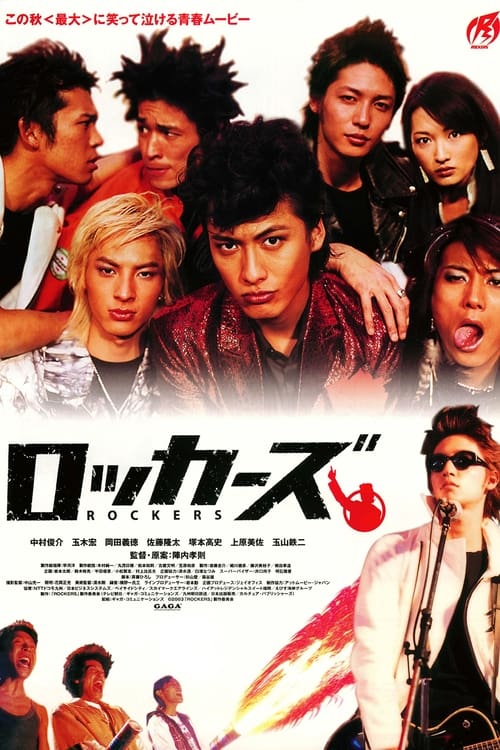
Guitarist Ko-chan is a mess of sexual repression after a childhood at the mercy of two elder sisters eager to use him as a guinea pig for their make-up skills. Bassist Gaku-chan keeps a bucket in the wings for whenever his nerves get the better of him, and drummer Momo-chan is doomed to forever carrying the botched childhood attempts at self-tattooing. It's not until this foursome is forced to look for an additional guitar player after Jin's dad burns his Stratocaster, that attitude and musical ability enter into the equation. Leather-clad, shade-wearing Tani (Tamaki), inseparable from his black Les Paul, is introduced as the king of R'n'R cool and Jinnai keeps him firmly seated on his throne throughout the film, retroactively proclaiming the guitarist, rather than himself, as the band's true hero.
2010

2005
2020

2013

2009
1991
2005
2001
No reviews yet. Be the first to share your thoughts on this movie!
Use the rating form above to leave a star rating and optional review.