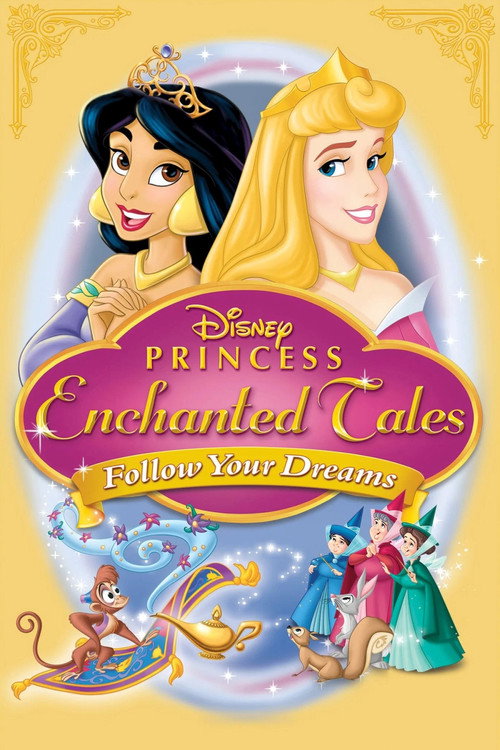
Disney Princess Enchanted Tales: Follow Your Dreams
2007
No user ratings available yet
Representation score: 3.3 out of 10

Representation Score
Fair
2005
Director
Rob LaDuca, Alan Zaslove, Toby Shelton
Average Rating
No ratings yetNew Showbiz Analysis
The film opens with Jasmine in her palace chambers, her boredom establishing the central tension: royal confinement versus personal freedom. This direct-to-video sequel relies on the original theatrical cast, using familiar voices to sell a message that individual desire outweighs public duty. The narrative frames the palace as a gilded cage, positioning Jasmine’s escape not as a political act but as a romantic one. Her competence is real—she makes decisions and navigates the city—but the heavy lifting falls to Aladdin and Genie. The sold meaning is clear: the highest good is personal happiness, specifically romantic love. The film’s argument is that class barriers dissolve when a princess and a street urchin fall in love, a resolution that preserves the kingdom’s stability while validating the individual’s right to choose. The last image, with Jasmine and Aladdin together, settles the moral verdict: the traditional hierarchy remains intact, but the female lead is rewarded for her autonomy. It is a safe, familiar package that treats the exotic setting as a neutral backdrop for universal themes. The film does not challenge the status quo; it simply allows the princess to leave her room. The camera loves Jasmine’s expressions of longing, framing her as the emotional center, but the structural power dynamics remain unchanged. It is a conservative affirmation of romantic love as the ultimate liberator.
Category Breakdown
The narrative centers on a strictly heterosexual romance between Jasmine and Aladdin. No same-sex intimacy or non-binary characters are depicted. The romantic resolution is the sole focus of the character arcs.
Jasmine drives the plot through her desire for freedom, yet her agency culminates in choosing a male partner. Aladdin remains the active problem-solver, while Jasmine’s competence is framed by her emotional journey and final union with him.
The cast features non-white phenotypes within a fictional Middle Eastern-inspired setting, treating the culture as a neutral backdrop. No characters are defined by racial stereotypes, but the diversity remains static and unexamined.
Royal duty is presented as a restrictive cage, validating individual happiness over public obligation. The class divide is bridged by romantic love rather than structural change, preserving the traditional hierarchy of the kingdom.
Absent. All characters possess idealized, healthy animated bodies with no depiction of physical, sensory, or cognitive impairments. Disability is not a narrative element or visual feature.
Present on Screen
Limited or Absent
2007
2006

2005
2008

2000
2005
2008
1994
No reviews yet. Be the first to share your thoughts on this movie!
Use the rating form above to leave a star rating and optional review.