
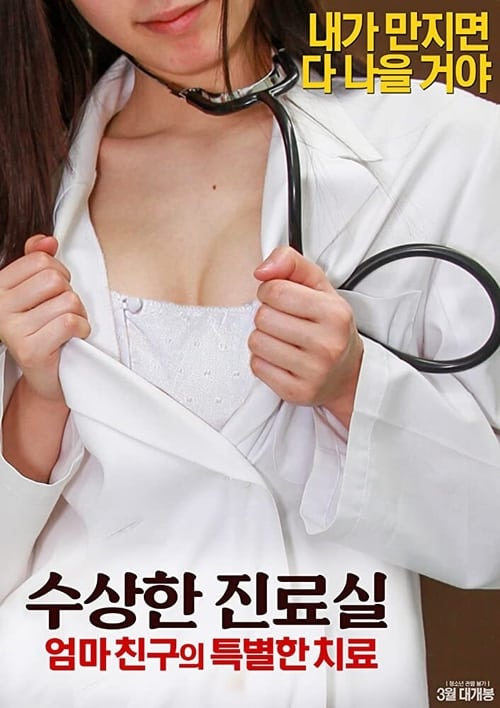
College Girls' Massage Parlor
2020
No user ratings available yet
Representation score: 1.8 out of 10
Representation Score
Fair
2018
Director
Kang Jeong-Hoon
Runtime
63 minutes
Average Rating
No ratings yetNew Showbiz Analysis
The film opens in a hospital room where a leg injury confines the male patient, Shin, to a bed, placing him under the care of Ayumi, a doctor who is also his mother’s friend. This setup establishes a hierarchy of care where physical vulnerability becomes the currency for intimacy. The narrative’s engine is Koharu, a nurse who discovers Shin’s private moments and seizes the opportunity to provide a "massage," transforming a medical necessity into a pretext for sexual contact. The camera lingers on the physicality of this exchange, treating the female characters’ initiative as the natural response to the male’s helplessness. The sold meaning is one of female agency within a constrained space: the women are not passive objects of desire but active participants who use their professional roles to access the male body. However, this agency is bounded by the traditional gender roles of the setting; the men are still the ones who need fixing, and the women’s power is exercised through caretaking. The film does not subvert the hospital’s authority but rather infuses it with erotic tension. Ayumi’s "secret" mirrors Koharu’s actions, suggesting a shared female complicity that bypasses the male patient’s autonomy entirely. The ending, implied by the genre and synopsis, resolves these tensions through mutual satisfaction rather than structural change. The hospital remains the same, the injury is treated, and the social bonds of the "mother’s friend" dynamic are reinforced. The film’s argument is that intimacy thrives in the cracks of professional duty, but it does not question the power dynamics that make such intimacy possible. It is a softcore drama that uses the language of care to explore desire, leaving the traditional hierarchies of gender and medicine intact while allowing for a momentary, consensual transgression.
Category Breakdown
No queer characters or same-sex intimacy appear. The plot relies entirely on heterosexual dynamics between the nurse and patient. Queer themes are absent from the narrative.
Nurse Koharu initiates physical contact, framing a massage as a response to the patient’s secret. Doctor Ayumi holds institutional authority. The male patient remains passive, his vulnerability triggering the women’s actions.
The cast includes Japanese actresses Yurina Aizawa and Makiko Ichinose. The film is directed by Korean Kang Jeong-Hoon. No non-Asian characters or broader ethnic diversity are evident in the credits.
The setting uses the traditional dynamic of a mother’s friend running a hospital. This invokes familial trust and social obligation. The film does not challenge these hierarchies, using them as a backdrop for intimate transgressions.
The male protagonist is hospitalized due to a leg injury. This restricts his mobility and necessitates care. The injury functions primarily as a plot device to enable physical proximity rather than exploring lived experience.
Present on Screen
Limited or Absent
Official Synopsis
A sick hospitalization life in a hospital run by a mother's friend. Shin, who injured her leg in an accident, is admitted to the hospital of her mother's friend Ayumi. Unable to bear the cravings accumulated in the increasingly prolonged hospital life, God secretly masturbates and gets caught by nurse Koharu. Rather than being surprised, Koharu covets God's secret place as an excuse for massage. Moreover, it turns out that Ayumi also has a secret secret.
2020

2012

2020

2002

2018

2010

2011

2018
No reviews yet. Be the first to share your thoughts on this movie!
Use the rating form above to leave a star rating and optional review.