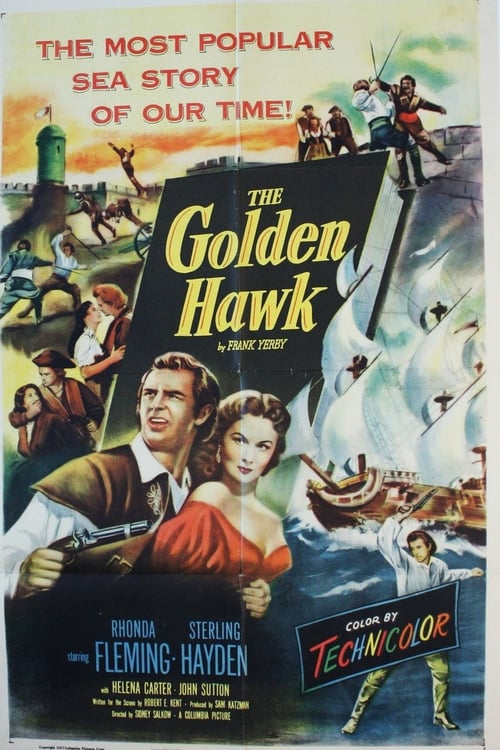
The Golden Hawk
1952
No user ratings available yet
Diversity score: 2.6 out of 10

1952
ApprovedDirector
Sidney Salkow
Runtime
81 minutes
Average Rating
No ratings yetSynopsis
After robbing a sea captain in New Orleans, a beautiful saloon girl flees and assumes a dead woman's identity.
Overall Score
Limited
Category Breakdown
LGBTQ+ Representation
The narrative focuses entirely on heteronormative romantic pursuits and traditional courtship. There is no evidence of queer subtext or non-cisnormative identities within the plot.
Gender Representation
The protagonist demonstrates agency by manipulating suitors to navigate economic instability. However, her arc ultimately reinforces traditional gender hierarchies and mid-century social expectations.
Racial & Ethnic Diversity
Set in New Orleans and San Francisco, the film focuses on a predominantly white cast. The story does not engage with racial diversity or use non-white characters as plot drivers.
Religious & Cultural Diversity
The film adheres to conventional Western morality and social structures. It lacks any significant deconstruction of religious frameworks or systemic oppression, focusing instead on melodrama.
Disability Representation
There is no meaningful depiction of disability or neurodivergence. A character's death serves as a plot catalyst, but physical vulnerability is used only as a narrative device.
Strengths
Areas for Improvement
AI Analysis
Scarlet Angel is a product of the 1952 studio system, prioritizing genre-driven escapism over narrative disruption. While the female lead, Roxy McClanahan, displays cunning and individual agency, her actions are contained within a predictable framework of class mobility and romantic resolution. The film relies heavily on established Hollywood archetypes. The storytelling follows a streamlined path that reinforces traditional social hierarchies rather than challenging them, resulting in a lack of intersectional depth.
No reviews yet. Be the first to share your thoughts on this movie!
Use the rating form above to leave a star rating and optional review.