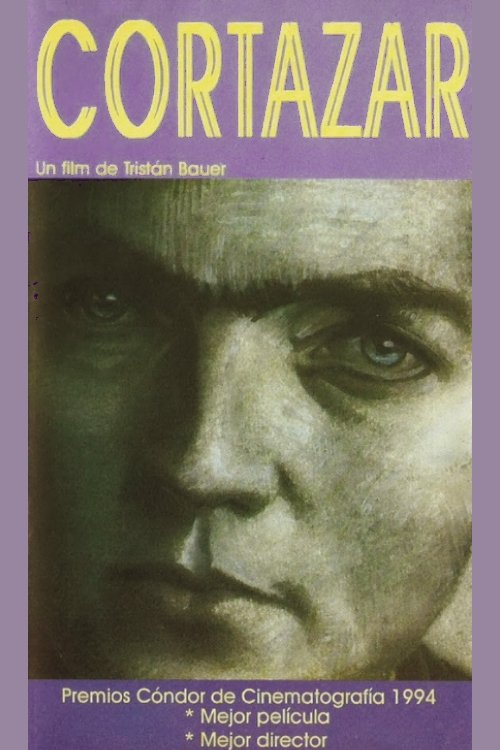
Cortázar
1994
No user ratings available yet
Representation score: 5.8 out of 10
Representation Score
Minimal
1986
AtpDirector
Alberto Fischerman
Runtime
110 minutes
Average Rating
No ratings yetNew Showbiz Analysis
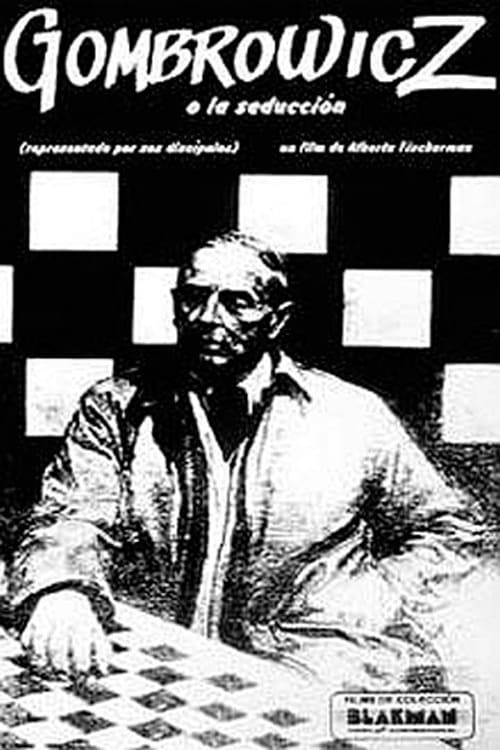
The film opens with five men seated in a static row, a visual that functions less as a documentary interview and more as a philosophical tribunal. Alberto Fischerman’s 1986 Argentine production uses this stark framing to dissect the legacy of Witold Gombrowicz, but the camera’s true subject is the mechanics of intellectual authority itself. The sold meaning is clear: the "self" is a constructed performance, yet the film simultaneously rewards the performer who maintains that construction. Mariano Betelú holds the floor as the mouthpiece, his confidence treated as the film’s moral center, while the other four men serve as a chorus of disciples whose earnestness is the running gag. The contradiction lies in the tension between the film’s stated thesis and its visual hierarchy. The men speak of the self as a lie, a product of seduction and audience validation. Yet, the pictures show a very solid, very present ego dominating the frame. Betelú never pays the price for his dominance; he keeps the last word and the camera’s sympathy. The disciples, by contrast, are trapped in their roles, their identities subsumed by the need to validate the central figure. The satire loves the uniform of the intellectual, treating the ego not as a flaw but as a necessary, beautiful architecture. The ending mirrors the opening: a freeze on the group, reinforcing that the performance never leaves the stage. The film’s argument is that identity is fluid, yet its structure is rigidly hierarchical. The Western, white, male intellectual sphere is the unmarked default, with no outside perspective to disrupt the internal debate. The camera likes the leader, not the followers. The final verdict is that while the self may be a fiction, the power to narrate that fiction is the only reality that matters. The disciples pay the cost of their proximity; the leader keeps the rank.
Category Breakdown
No same-sex intimacy or queer identity appears. The five men perform a static legacy, leaving the film’s queer potential entirely unspoken.
Five men occupy the frame, with no women present. The intellectual hierarchy remains unchallenged, positioning male ego as the sole, unexamined authority.
The cast is exclusively white, reflecting the unmarked default of the Western intellectual sphere. No non-white individuals appear to disrupt the internal debate.
The film centers Witold Gombrowicz’s legacy, framing his exile as a cultural event. The disciples validate the central figure, treating his ego as a necessary, beautiful architecture.
No disabled individuals appear on screen. The static framing of the five men offers no representation of physical or cognitive difference.
Present on Screen
Limited or Absent
Official Synopsis
Gombrowicz or seduction rebuilds, from the margins of the official film, the figure of Witold Gombrowicz. Peripheral par excellence, at the end of the 30's the renowned author of Ferdydurke and transatlantic came to stop the Argentina and stayed here for thirty years. Inevitably fragmentary, given the personality on the run of the own Gombrowicz (and the own Fischerman, In short)
1994

2000
2002
2020
1986
1990
2018
2009
No reviews yet. Be the first to share your thoughts on this movie!
Use the rating form above to leave a star rating and optional review.