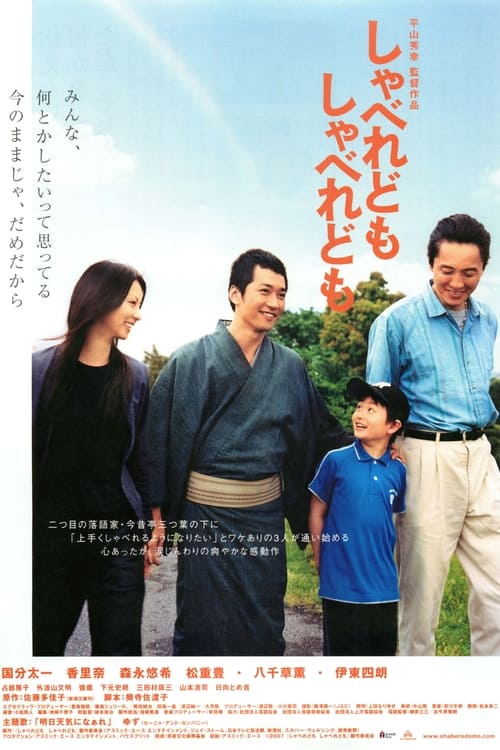
Talk, Talk, Talk
2007
No user ratings available yet
Representation score: 6.0 out of 10

Representation Score
Good
2019
Director
Masayuki Suō
Runtime
129 minutes
Average Rating
No ratings yetNew Showbiz Analysis
Talking the Pictures is a sophisticated historical drama that centers on preserving a disappearing art form. It delves into the subtleties of early 20th-century Japanese social life and the passion for cinema. The film is rooted in cultural and historical authenticity, valuing thematic depth over contemporary multi-layered signals. Though it does not aggressively dismantle traditional hierarchies, it offers a respectful and humane portrayal of its characters. Overall, the work avoids harmful stereotypes, though it remains limited in its portrayal of underrepresented identities and diverse viewpoints.
Category Breakdown
The story focuses on the professional and artistic ambitions of the protagonist within the benshi tradition. It does not prominently feature non-traditional gender identities or same-sex relationships as key plot points.
The narrative emphasizes intellectual and artistic pursuits set in a historical context. Although the story is centered around male characters, it avoids portraying women in submissive roles or using misogynistic clichés.
Set in a small Japanese village a century ago, the film portrays a culturally uniform environment. While this reflects historical accuracy, it does not include diverse ethnicities or characters who reflect more than one aspect of diversity.
The film highlights artistic expression and engagement with media. It critiques passive culture consumption by focusing on the benshi role rather than rigid social structures.
There is no prominent depiction of visible or invisible disabilities. Characters are primarily defined by their professional goals and their connection to the film medium.
Present on Screen
Limited or Absent
Official Synopsis
Set at a movie theater in a small village around 100 years ago. Silent films are play at the movie theater. A young man aspires to become a benshi, a performer that provides live narration to silent films.
2007
2003
2014
2005
2025

2015
2013
1937
No reviews yet. Be the first to share your thoughts on this movie!
Use the rating form above to leave a star rating and optional review.