
Love Always, Santa
2016
No user ratings available yet
Representation score: 1.3 out of 10
Representation Score
Minimal
2026
Director
Jeff Beesley
Average Rating
No ratings yetNew Showbiz Analysis
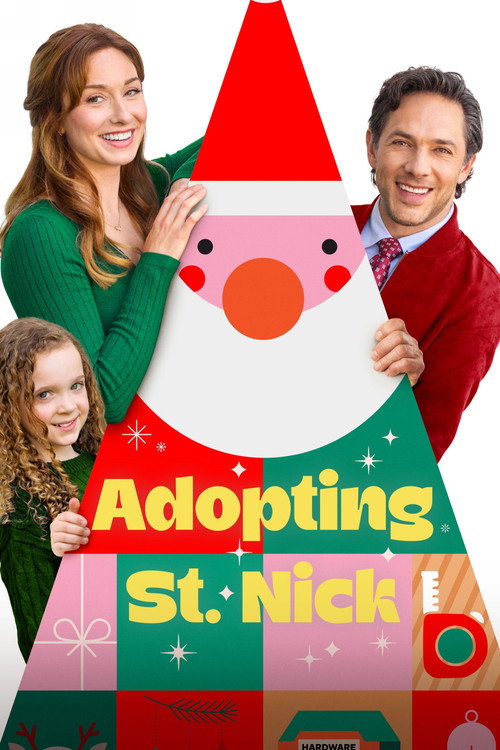
Adopting St. Nick opens with the quiet, grease-stained reality of a single mother’s life, where Maren’s competence is measured by her ability to keep a household running and a child fed. The film’s argument is straightforward: loneliness is cured by community, and single parenthood is a temporary state resolved by romantic partnership. Maren’s arc is one of emotional labor, where her value is derived from her care for others, particularly her daughter Leah and the elderly residents of Jolly Acres. The camera treats her domesticity as a virtue, framing her single status not as a choice but as a gap to be filled by Reid, a charming resident who offers validation and a return to traditional couplehood. The narrative’s internal logic is consistent but unchallenging. The "adoption" of a grandparent is presented as a wholesome, low-stakes adventure that reinforces intergenerational bonds without questioning the power dynamics of care. The film’s ending likely settles into a warm, communal embrace, where the holiday spirit and small-town values serve as the moral verdict. Maren is rewarded not for independence, but for her ability to integrate into a traditional family structure, with Reid’s presence completing her emotional landscape. The film sells a vision of stability where the old and the young, the single and the paired, find harmony through shared tradition and mutual care. It is a gentle, unproblematic affirmation of Western norms, where the last image is one of collective warmth, and the individual’s needs are subsumed by the community’s expectations.
Category Breakdown
No queer characters or relationships appear. The romance is strictly heterosexual, with no coded subtext or alternative family structures depicted in the cast or dialogue.
Maren’s competence is framed through domestic labor and emotional care. Her single status is treated as a temporary deficit resolved by Reid, who serves as the romantic prize and source of external validation.
The cast is overwhelmingly white, relying on a homogeneous small-town aesthetic. No non-white characters are named or depicted in the core family or community dynamics.
The film celebrates Western holiday traditions and intergenerational bonding. The adoption of a grandparent reinforces familial duty, with community values serving as the moral center.
No characters are depicted with physical, cognitive, or sensory disabilities. Elderly residents are portrayed as active and capable, with no focus on impairment or specific care needs.
Present on Screen
Limited or Absent
Official Synopsis
A single mother finds unexpected romance while helping her daughter connect with a Santa-like resident at a retirement community.
2016

2011

2020

2026

2020

2025

2023

2023
No reviews yet. Be the first to share your thoughts on this movie!
Use the rating form above to leave a star rating and optional review.