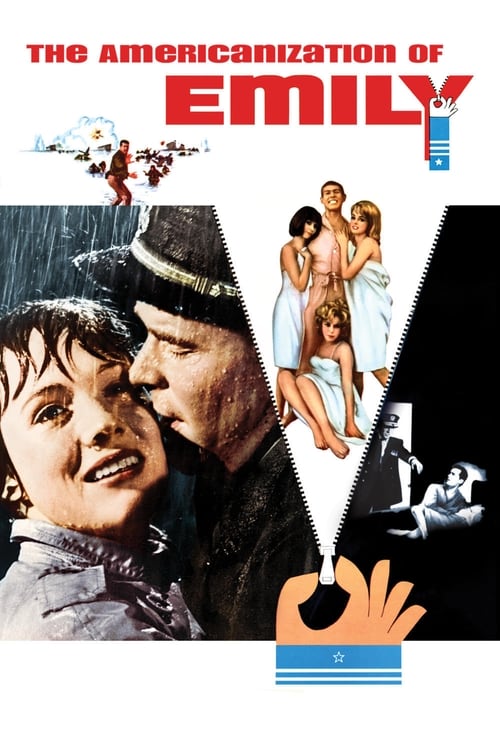
The Americanization of Emily
1964
No user ratings available yet
Diversity score: 4.3 out of 10

1926
PassedDirector
Lloyd Bacon
Runtime
80 minutes
Average Rating
No ratings yetSynopsis
Isadore "Izzy" Goldberg changes his name to I. Patrick Murphy because his store is in an Irish-neighborhood in New York City. He meets Eileen Cohannigan, the daughter of a meat-packer, and he tells her he is Irish and a romance begins. When America enters World War I, "Izzy" enlists, is sent to France, and is wounded while engaged in a heroic rescue during a big battle. While recovering in an overseas hospital, he writes Eileen and tells her he is Jewish and not Irish. Returning home, he is parading with his regiment and he sees Eileen with Robert O'Malley, his old rival. He thinks she has thrown him over because he is Jewish. An Irish lodge comes to bestow an honor on the man they think is Patrick Murphy, an Irish hero. But O'Malley tells them his real name is Goldberg. But Eileen tels him it is he she loves, and they head for the marriage-license bureau.
Overall Score
Fair
Category Breakdown
LGBTQ+ Representation
The film focuses entirely on heteronormative romance. There is no depiction of same-sex intimacy or non-cisnormative identities.
Gender Representation
Eileen serves as the emotional catalyst for the protagonist. While she possesses the agency to validate his true identity, the story remains tied to conventional romantic tropes.
Racial & Ethnic Diversity
The story explores the intersection of Jewish and Irish identities in New York. It highlights the social pressures that drive identity performance and ethnic assimilation.
Religious & Cultural Diversity
The narrative examines the friction between different immigrant enclaves. It uses institutions like the Irish lodge to illustrate social pressure and the complexities of community life.
Disability Representation
Wartime injuries function primarily as a plot device for character reflection. The film lacks depth regarding neurodivergence or long-term disability.
Strengths
Areas for Improvement
AI Analysis
Private Izzy Murphy offers a sophisticated look at ethnic identity and the performance of heritage in early 20th-century America. By centering on a protagonist who masks his Jewish identity to fit into an Irish neighborhood, the film moves beyond simple melting pot tropes to examine the pressures of immigrant social mobility. However, the film is heavily constrained by the era's traditional structures. The narrative relies on heteronormative romantic arcs and uses physical injury merely as a way to advance the plot rather than exploring disability with agency. Ultimately, while the film provides a nuanced commentary on assimilation and ethnic tension, it remains anchored to conventional social stabilizers like marriage and traditional courtship.
No reviews yet. Be the first to share your thoughts on this movie!
Use the rating form above to leave a star rating and optional review.
