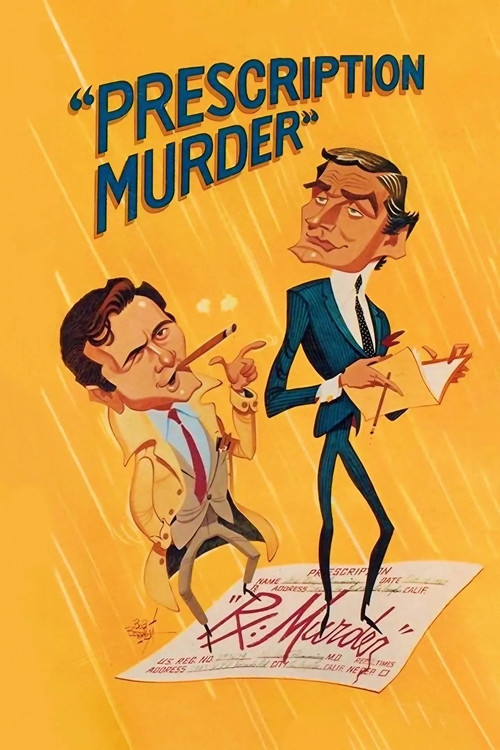
Prescription: Murder
1968
No user ratings available yet
Representation score: 3.0 out of 10
Representation Score
Minimal
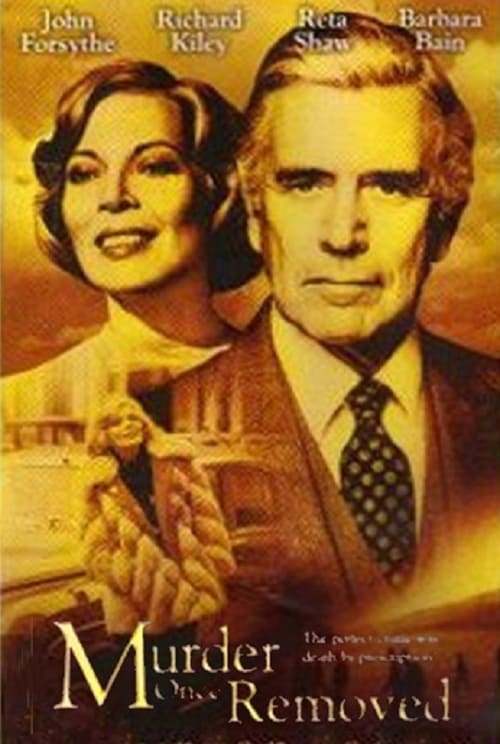
1971
Not RatedDirector
Charles S. Dubin
Runtime
74 minutes
Average Rating
No ratings yetNew Showbiz Analysis
Murder Once Removed is a standard crime thriller that adheres strictly to the social and narrative conventions of early 1970s television. The story prioritizes individual morality and the mechanics of a cover-up over any meaningful exploration of identity or social hierarchy. The film lacks intentionality regarding the way different parts of someone's identity overlap. It functions as a character-driven drama that reinforces the traditional archetypes and homogeneous casting common to the crime genre of its time. Ultimately, the work serves as a product of its temporal context, offering a conventional viewing experience without attempting to challenge established social structures.
Category Breakdown
The film focuses on romantic motives for murder, which aligns with the assumption that everyone is straight or cisgender, typical of 1971 television. There is no evidence of non-assuming gender matches what was assigned at birth identities or critiques of traditional romantic archetypes.
The narrative centers on a scheming doctor driven by interpersonal passion. It maintains conventional gendered power dynamics without showing women exercising a significant role in driving the story.
Reflecting the era's tendency toward homogeneous casting, the film lacks indications of non-white majority ensembles. It appears to function within a traditional, Western-centric social framework.
The plot focuses on individual culpability and the consequences of criminal actions. It follows established legal and moral consequences rather than critiquing systemic institutions or prioritizing moral relativism.
The film contains no mention of characters with physical, sensory, or neurodivergent disabilities. No representation in this category is present.
Present on Screen
Limited or Absent
Official Synopsis
Television thriller in which a scheming doctor murders once for love and then has to kill again to cover it up.
1968

1958
1990

1971
1994
1981

1982
1974
No reviews yet. Be the first to share your thoughts on this movie!
Use the rating form above to leave a star rating and optional review.